Homegrown Energy series | Part II
Homegrown Energy: A policy blueprint for energy affordability
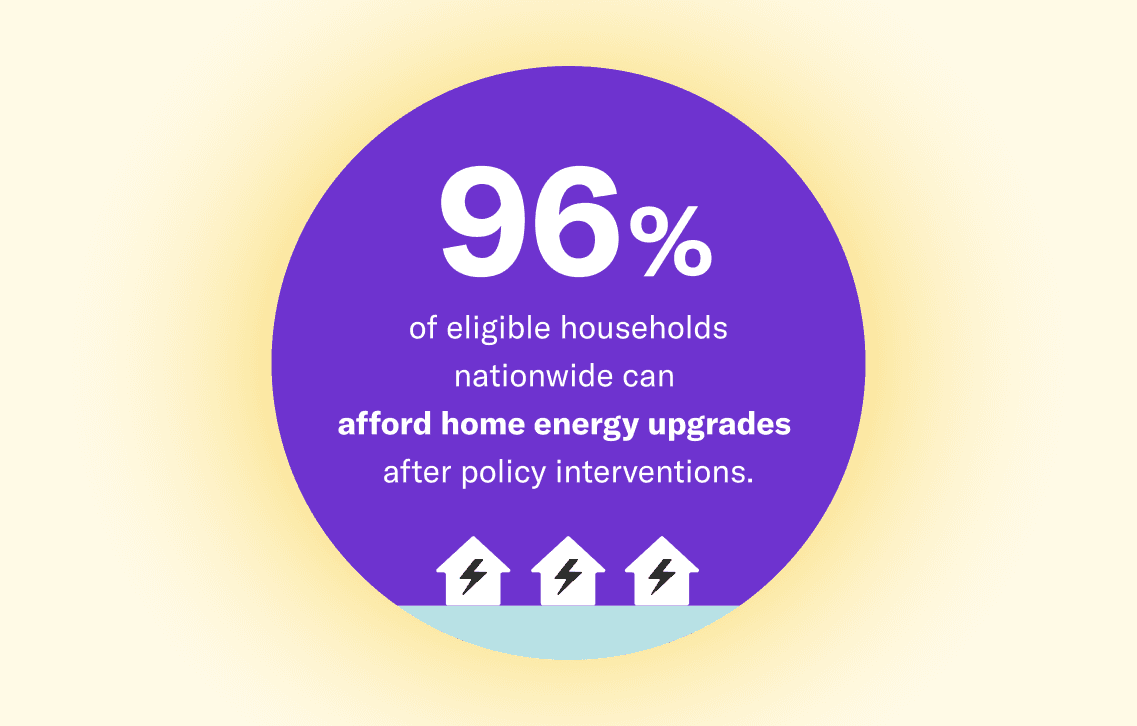
Bundled policy interventions make home energy upgrades affordable for 96 percent of eligible households nationwide.
Download the reportIntroduction
Americans are facing a growing energy affordability crisis. Rising bills — driven by aging infrastructure, rapid data center growth, and fossil fuel volatility — are putting increasing strain on household budgets, and these pressures will only intensify as demand surges and gas system costs rise.
Addressing this challenge will require massive investment in the energy system. It also presents a generational choice: whether this spending reinforces a model that concentrates wealth among large energy and technology companies, or builds one that lowers costs, strengthens communities, and centers households.
That choice is already taking shape. Communities are increasingly wary of large-scale data center development that would drive up costs, consume land and water, and deliver few direct benefits. At the same time, utilities are projected to spend more than $1.4 trillion by 2030 to expand electricity and gas systems, costs that will ultimately flow to customer bills without deliberate policy intervention.1
Yet nearly 9 out of 10 single-family households are effectively blocked by current policy from accessing solutions that would lower their bills and give them greater control over their energy use: whole-home electrification, rooftop solar, and battery storage. The result is a misaligned system, where households are being asked to pay for a massive infrastructure buildout while being denied access to the very solutions that would help them save.
Treating households as energy infrastructure fundamentally changes this equation.
Through six self-reinforcing policies, states can redirect a portion of energy system investment toward home energy upgrades, lowering system costs, reducing unnecessary infrastructure, and delivering immediate benefits to communities.
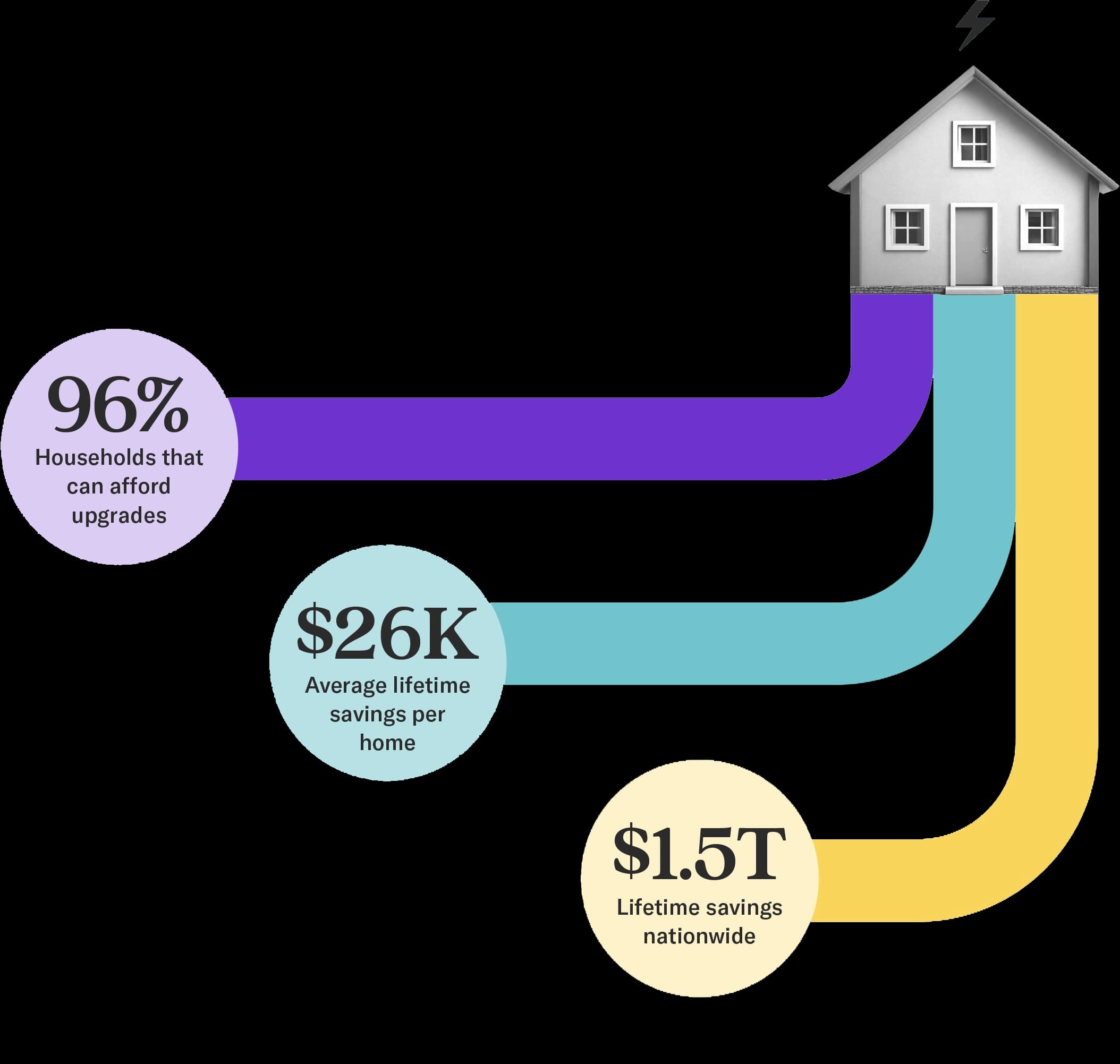
The impact is substantial. These policies can make electrification, solar, and storage affordable for 96 percent of eligible households, unlocking an average of $26,000 in lifetime savings per home and $1.5 trillion in total lifetime savings nationwide. They would also create more than 1.1 million durable, community-based jobs that cannot be outsourced or automated.2
This is the foundation of a new model: an energy system built on community power.
At key moments in American history, energy has shaped prosperity. Under Franklin D. Roosevelt and the New Deal, rural electrification helped power one of the greatest periods of economic growth in the country’s history. Today, we face a similar opportunity.
This report shows how to seize it — and build an energy system that is faster, more affordable, more resilient, and that puts American households first.
– Ari Matusiak, Founder and CEO, Rewiring America
Executive summary
A coordinated set of policies can make whole-home electrification, rooftop solar, and battery storage affordable for 96 percent of eligible U.S. households, delivering $26,000 in average lifetime savings per home, or $1.5 trillion nationwide.
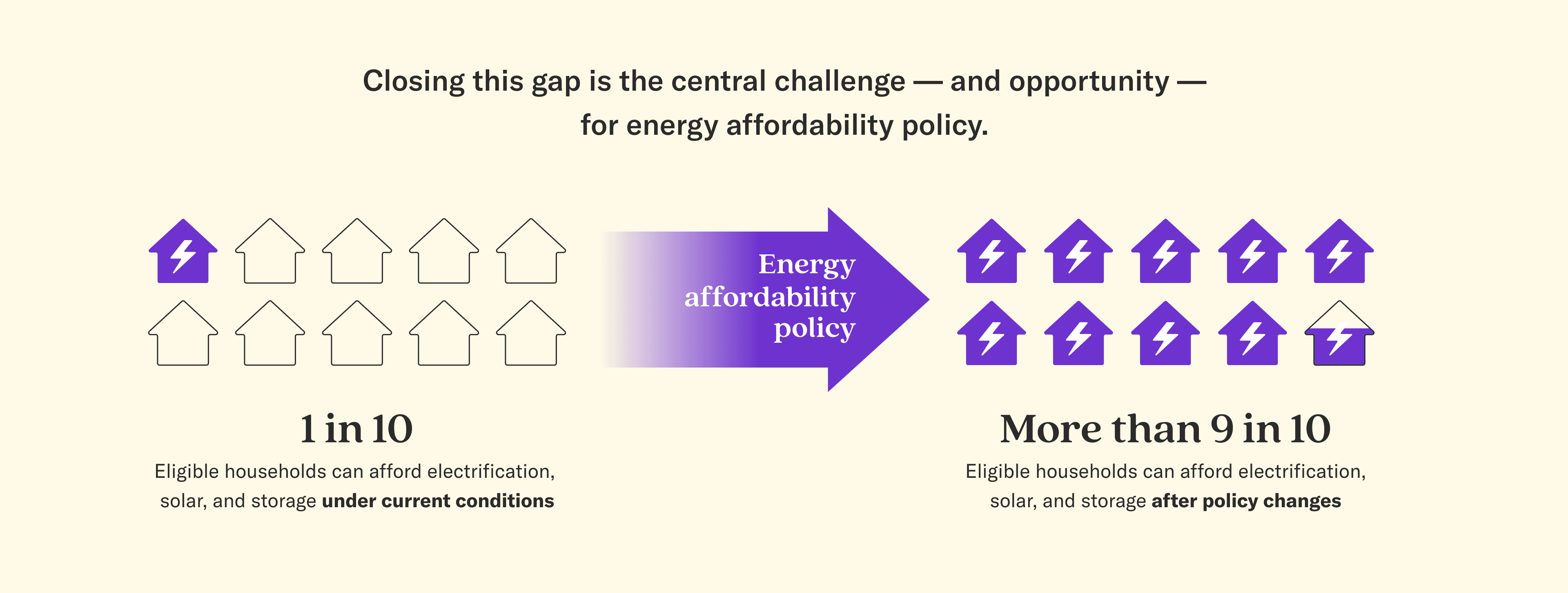
Today, those same upgrades are affordable for only about 9 percent of households under current market conditions, without incentives. Home electrification alone is affordable for roughly 40 percent of U.S. households.
Home electrification and weatherization improve comfort, reduce indoor air pollution, and lower overall energy use. When paired with rooftop solar and battery storage, homes become energy assets, able to generate, store, and manage power. At scale, these resources can reduce peak demand, improve reliability, and avoid costly new infrastructure.
Yet today’s energy system does not recognize this value. Current rules raise costs through unnecessary permitting barriers, limit access to affordable financing, and fail to compensate households for the grid services they provide. At the same time, households are asked to fund large-scale system investments through their energy bills, even when those investments deliver limited direct benefit.
The solution is not more subsidies — it is to fix the system. By reshaping incentives and economics to capture the value of household energy infrastructure, policymakers can shift affordability from 1 in 10 eligible households to more than 9 in 10. This report identifies six market-based policies that lower costs, bring in new capital, and ensure households are paid for the value they provide:
Reducing soft costs
Requiring large new energy users to invest in distributed resources
Enabling inclusive utility investment
Modernizing rate design
Redirecting gas infrastructure investment
Scaling virtual power plants
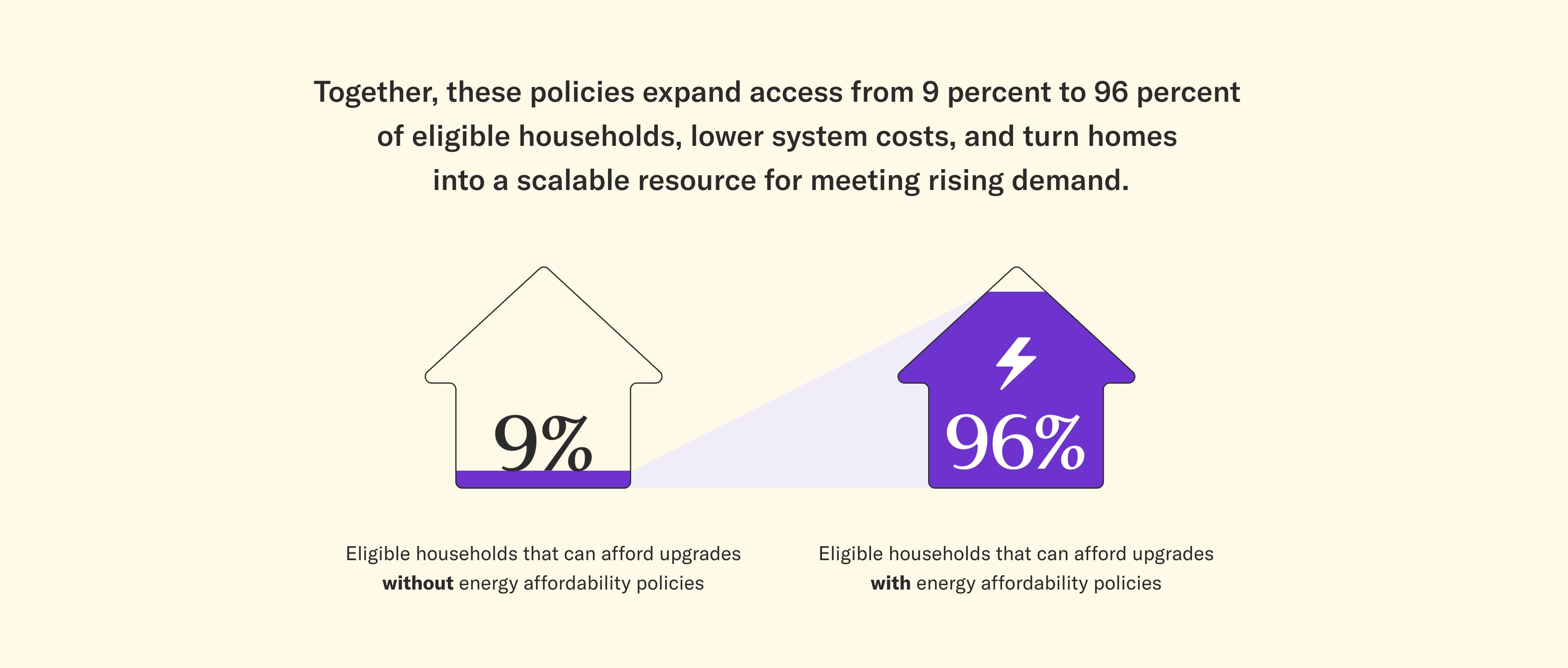
Energy policy should deliver results families can see in their homes and on their bills. By treating households as energy infrastructure and aligning investment with household savings, these policies address one of the country’s most pressing economic challenges while delivering immediate, tangible benefits. This report outlines how to turn a system people feel burdened by into one they directly benefit from.
How we define affordability
We define affordability as a household’s ability to adopt home energy upgrades at the same or lower total cost — accounting for both upfront and operating costs — as replacing existing equipment with new like-for-like systems.
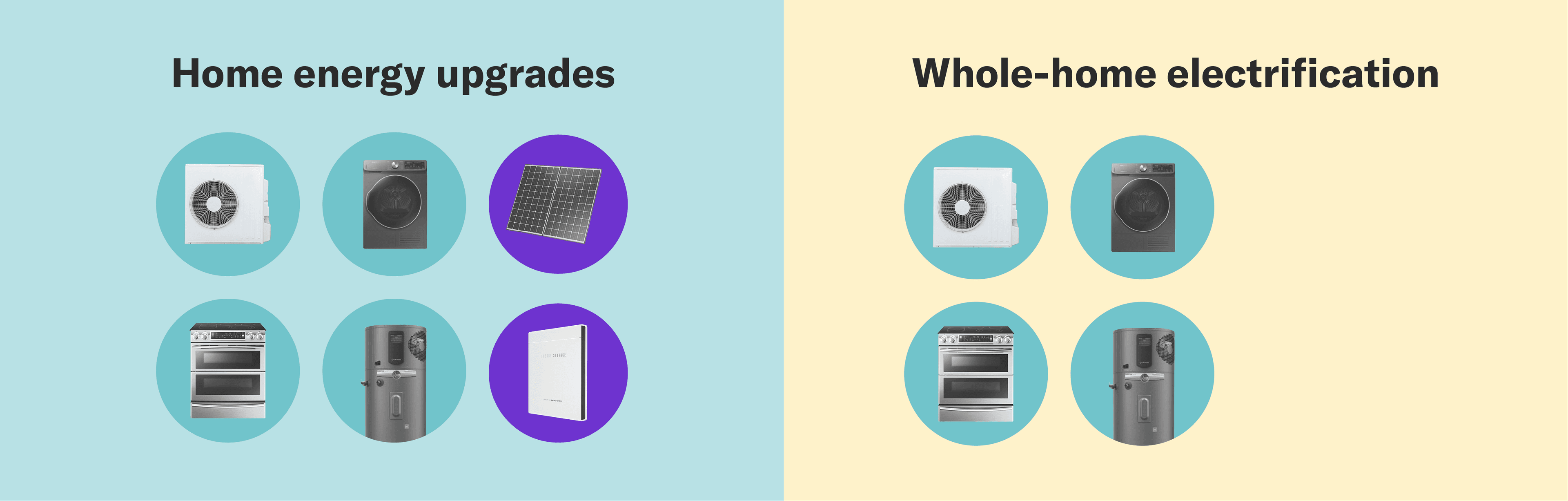
“Home energy upgrades” includes whole-home electrification, rooftop solar, and battery storage. “Whole-home electrification” refers to upgrading key home appliances — heating and cooling, water heating, clothes drying, and cooking — to high-efficiency electric machines. Space conditioning and water heating systems are upgraded to heat pumps regardless of their previous fuel type, while clothes drying and cooking are upgraded only where they are not already electric.
We do not explicitly model weatherization in this analysis, though we recognize its important role in lowering energy use and bills, improving comfort, and enhancing the performance of electrification upgrades.
We model the effect of home energy upgrades across 68 million “eligible households,” that is, all single-family households except those where heat pumps have already been installed and those without any form of heating currently present. We recognize that not all households will be able to adopt every technology, especially rooftop solar, in practice.
Read our technical methodology for more information.
Three key strategies
This roadmap focuses on three interlocking strategies to advance energy affordability:

Remove barriers to electrification.
High upfront costs, limited financial solutions, and uncertain operating costs prevent many households from adopting efficient electric technologies. Addressing these barriers is a prerequisite to unlocking both household savings and system-wide benefits.
Recognize households as grid assets.
Home upgrades not only benefit occupants but can also provide significant value to the energy system. Battery storage, heat pumps with smart controls, and rooftop solar can deliver power or reduce demand when the grid is stressed. These resources already exist or can be built quickly, making them a competitive source of clean energy if their value is recognized.
Drive energy investment toward households.
An enormous amount of capital — from both hyperscalers and ongoing utility investment — is flowing into the energy system. Properly valuing households as grid assets can redirect a portion of that investment toward home upgrades that reduce bills and strengthen the grid.
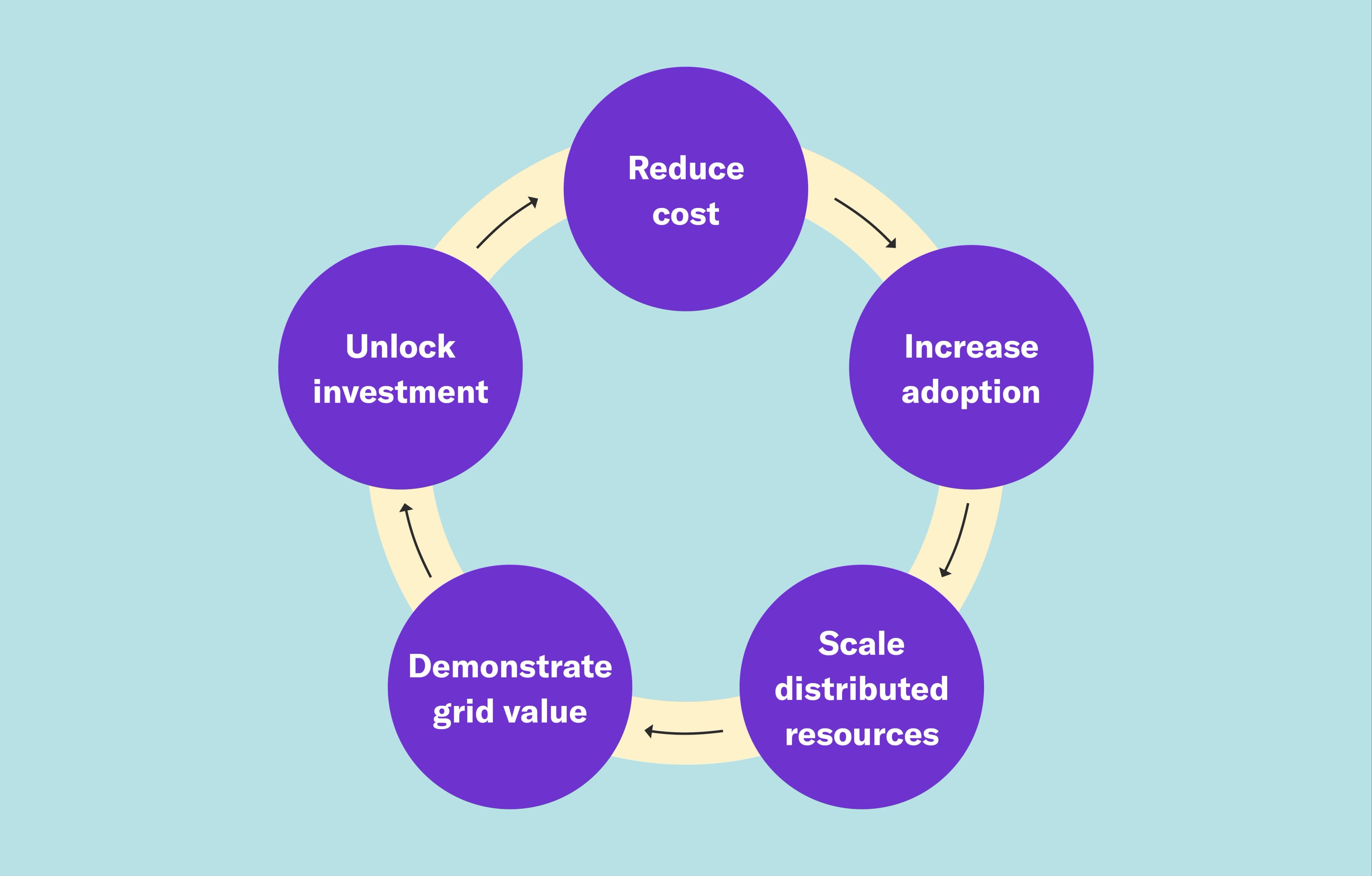
These three strategies reinforce one another, creating a virtuous cycle: Making home electrification more affordable enables widespread adoption. Greater scale increases the availability of distributed resources that can be aggregated and treated as grid assets. Proving that households are reliable grid assets creates a stronger case for hyperscalers and utilities to invest in them. This increased investment, in turn, makes home electrification more affordable — driving down costs over time and reducing the need for ongoing interventions.
Six priority policies
This roadmap highlights six priority policy approaches that build on one another to lower both upfront and operating costs and enable household energy resources to meet rising electricity demand more efficiently and cost-effectively. The specific design and implementation of these policies will vary based on local system conditions.
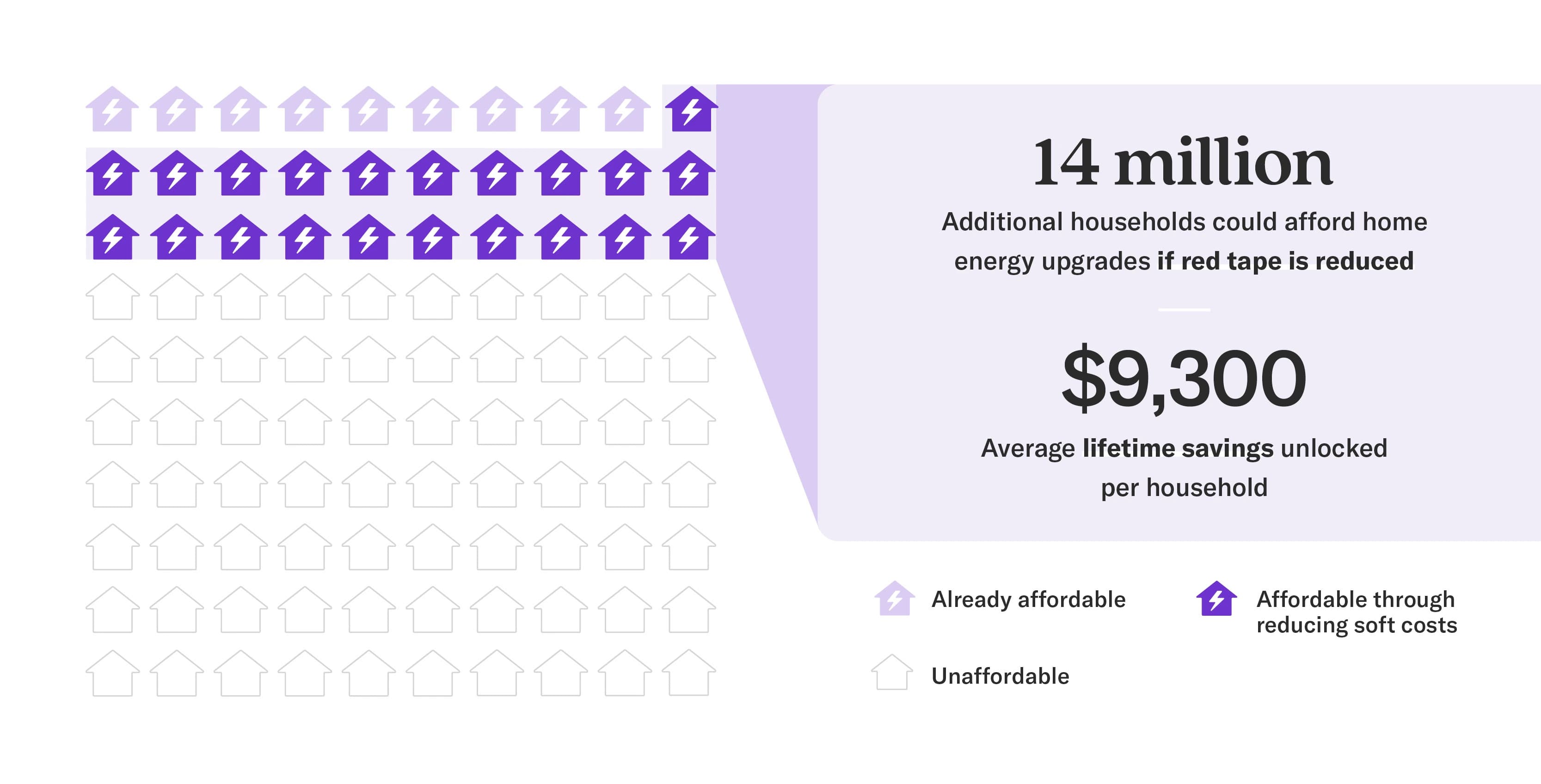
Soft cost reductions. Soft costs account for more than half of residential solar and storage costs in the U.S.3 Streamlining permitting, inspection, and interconnection processes makes upgrades affordable for an additional 14 million households.
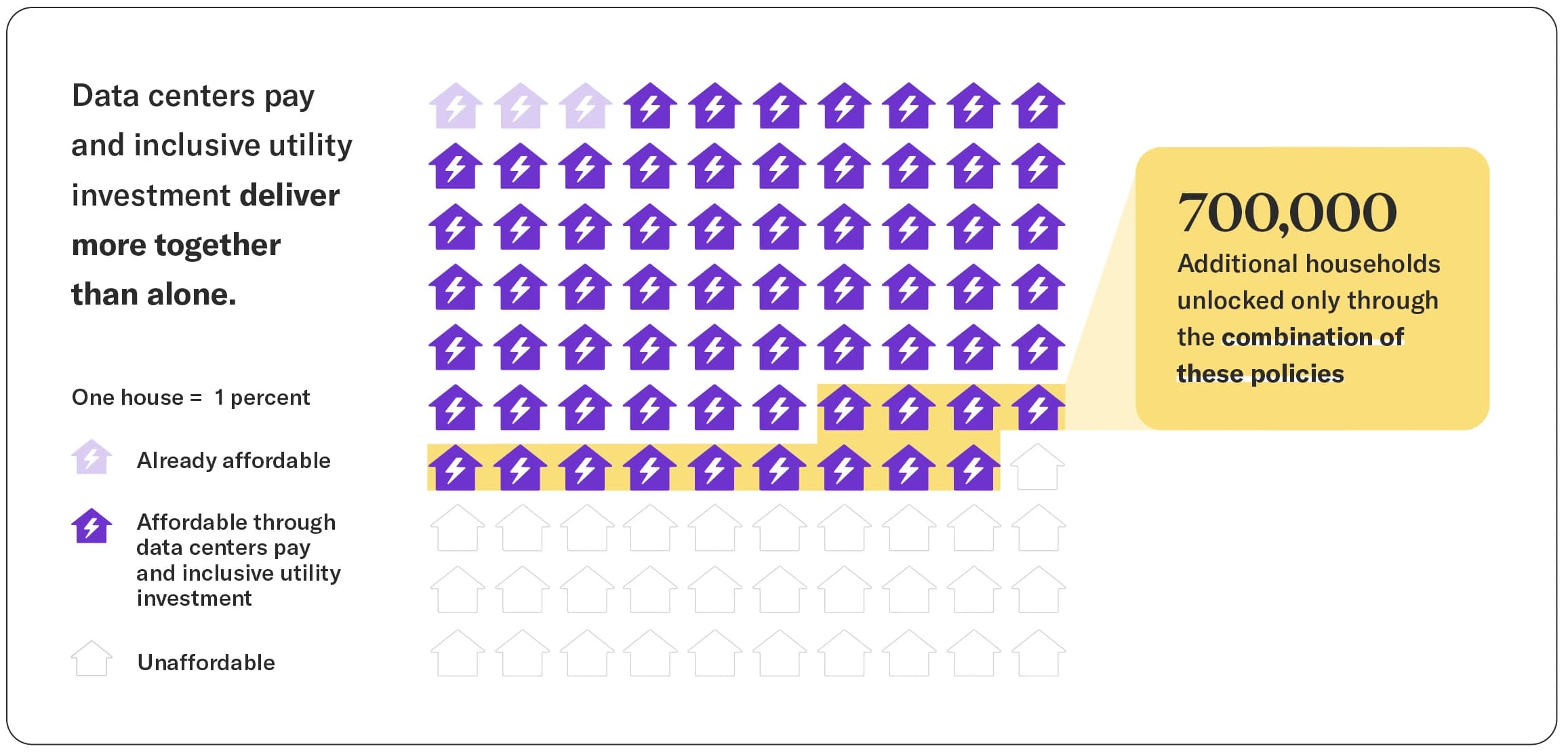
Because reducing soft costs improves the economics of every upgrade and policy, we treat it as a baseline condition for the rest of the analysis. In other words, the impacts of the remaining policies are modeled on top of a system where these costs have already been reduced.Data centers pay. AI data centers in the U.S. are projected to add more than 100 GW of new electricity demand to the grid by 2030.4 Incentivizing data centers to fund a portion of their capacity needs through distributed resources could mobilize billions in private capital for home energy upgrades while reducing costly infrastructure expansion. This intervention makes upgrades affordable for an additional 19 million households.
Inclusive utility investment (IUI). IUI enables utilities to pay for home improvements with low or no upfront cost or credit check to the household, recovering costs through a monthly bill charge that is tied to the property, not the individual. These programs expand access to low-cost capital and make upgrades affordable for an additional 18 million households.
Electrification-friendly rate reform. Outdated, static electric rates cause heat pump households to overpay relative to their actual system costs. Seasonal rates, time-of-use structures, and heat pump tariffs can reduce bills by 10 to 50 percent.5 Because upfront costs — particularly for solar and storage — dominate the total upgrade package, the impact of reducing heat pump operating costs on full-package affordability is modest. However, for whole-home electrification alone, heat pump-friendly rate design has a much larger effect, making upgrades affordable for an additional 5 million households.
Non-pipeline alternatives (NPAs). Gas utilities spend billions annually on pipelines that lock in long-term rate increases. Redirecting that spending toward electrification and efficiency avoids unnecessary capital investment and protects households from rising gas system costs, making upgrades affordable for an additional 20 million households.
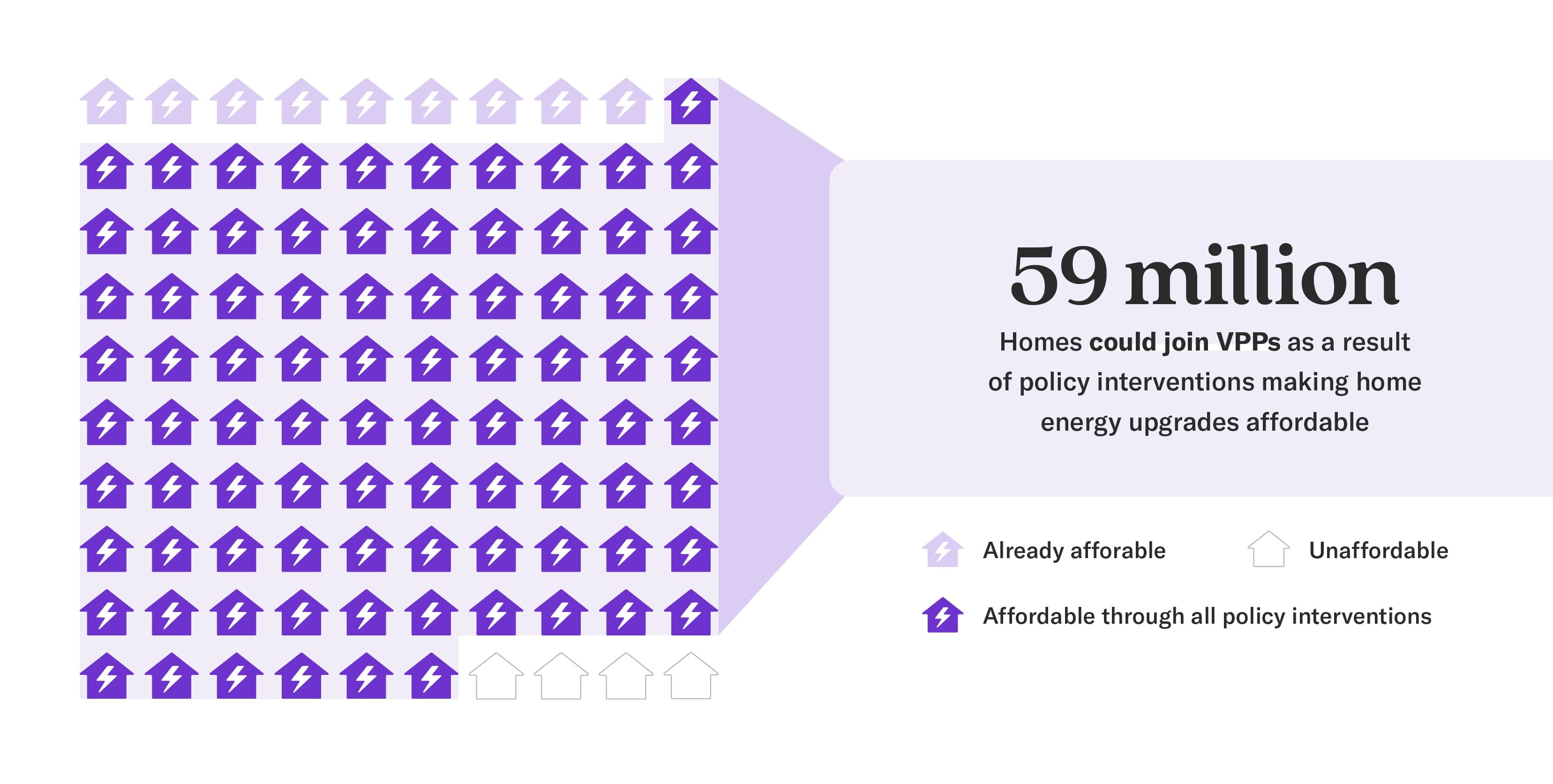
Virtual power plants (VPP). Aggregating household-based energy resources is a faster, lower-cost way to meet rising electricity demand than building new power plants. The policies outlined above make home energy upgrades affordable for approximately 59 million additional households, all of which could participate in VPPs — turning homes into a scalable source of grid capacity. We do not model VPPs as a standalone intervention, as program design varies significantly and much of their household affordability impact is captured within the “data centers pay” pathway.
While this report focuses on six priority policy approaches, there are a range of additional, complementary policies that can also play an important role in improving energy affordability. Those include weatherization and building retrofit programs; governance and accountability frameworks for large electricity users; integrated gas and electric system planning; non-wires alternatives and grid utilization standards; utility incentive reforms such as performance-based regulation; equipment incentives; community solar and storage programs; and bill assistance or percentage of income payment plan protections. While important, these are not the primary focus of this report either because they are well covered elsewhere or because they fall outside the central framework explored here.
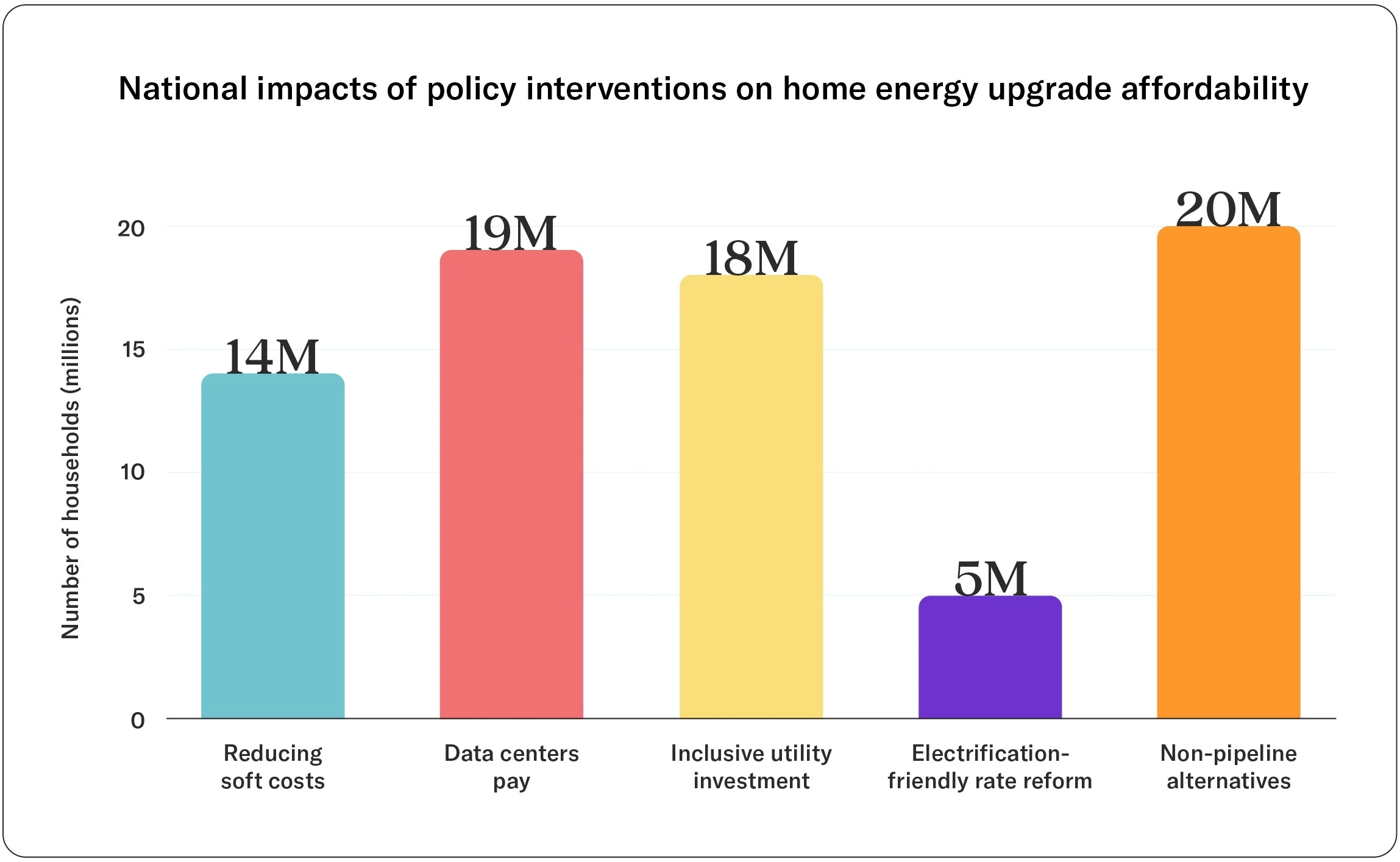
Regional impacts of policy interventions on home energy upgrade affordability
Color scale shows percentage point increase in households where upgrades are affordable
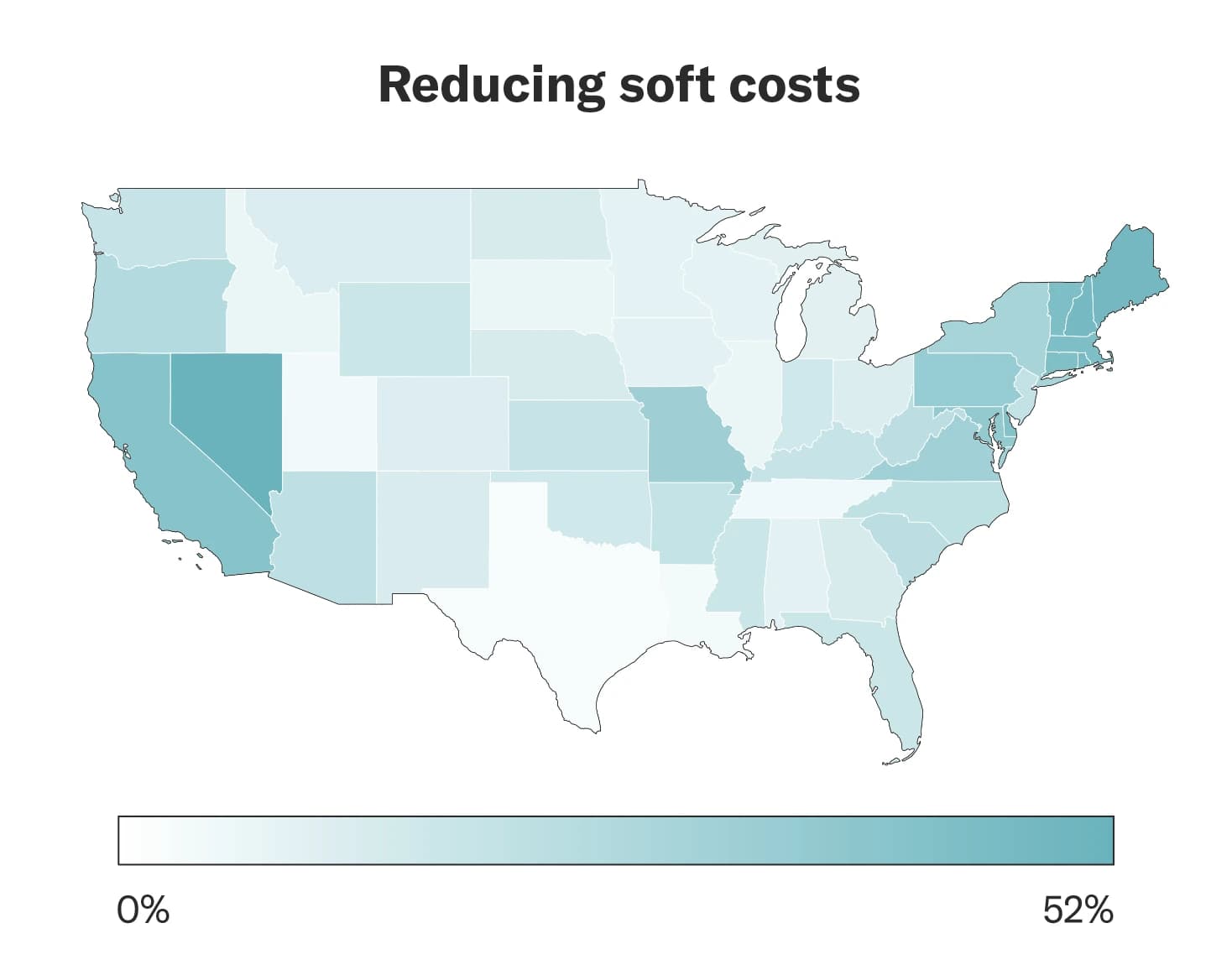
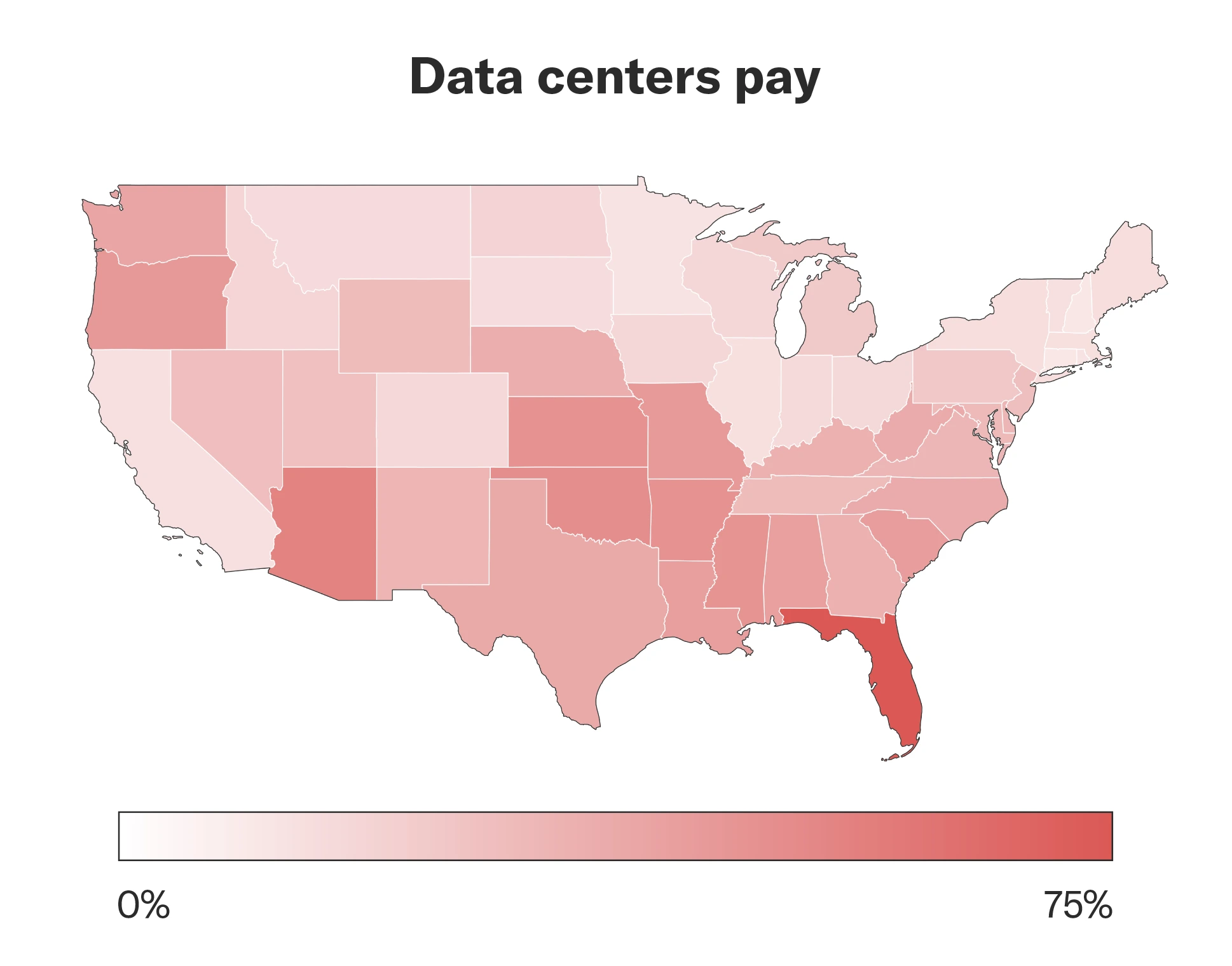
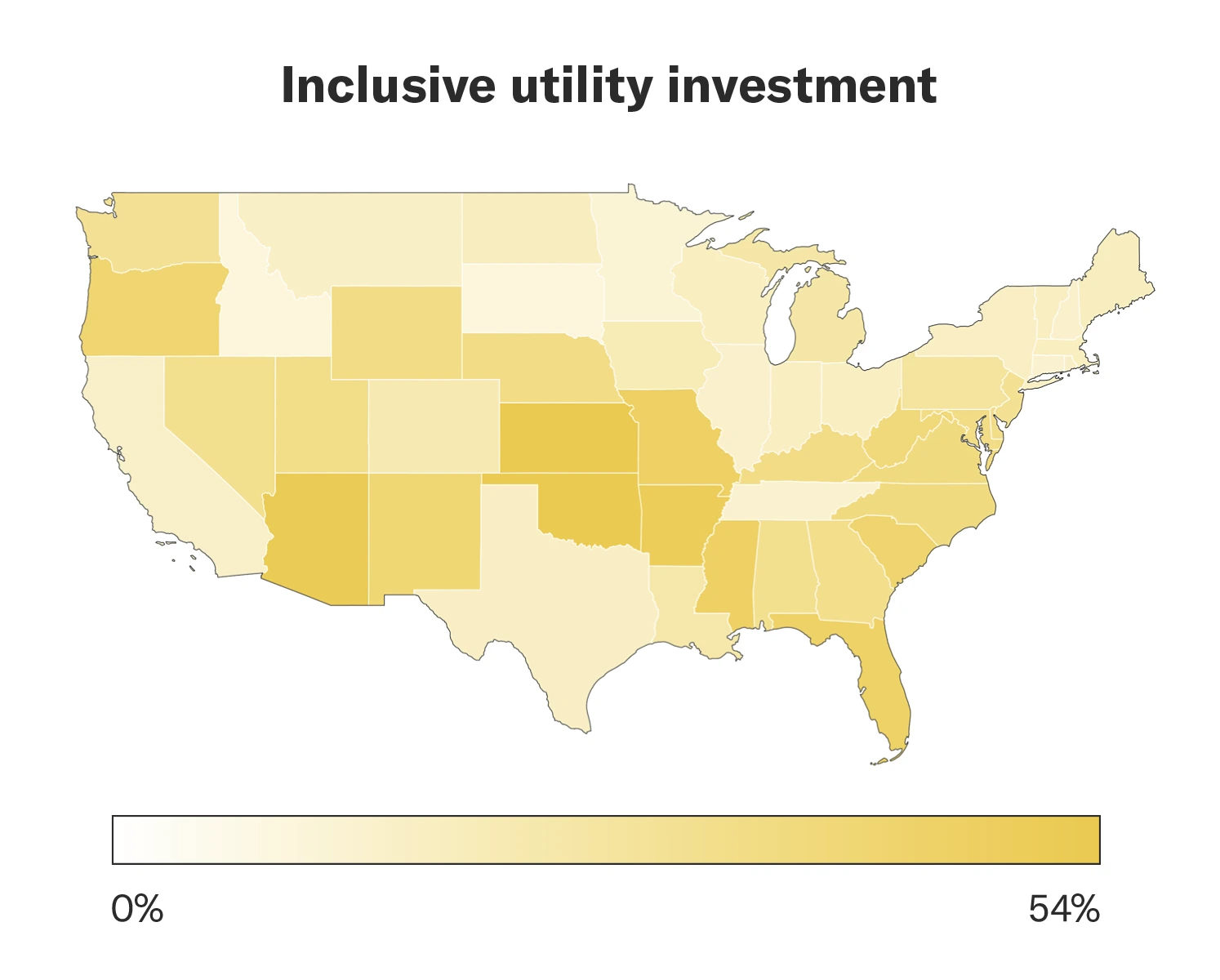
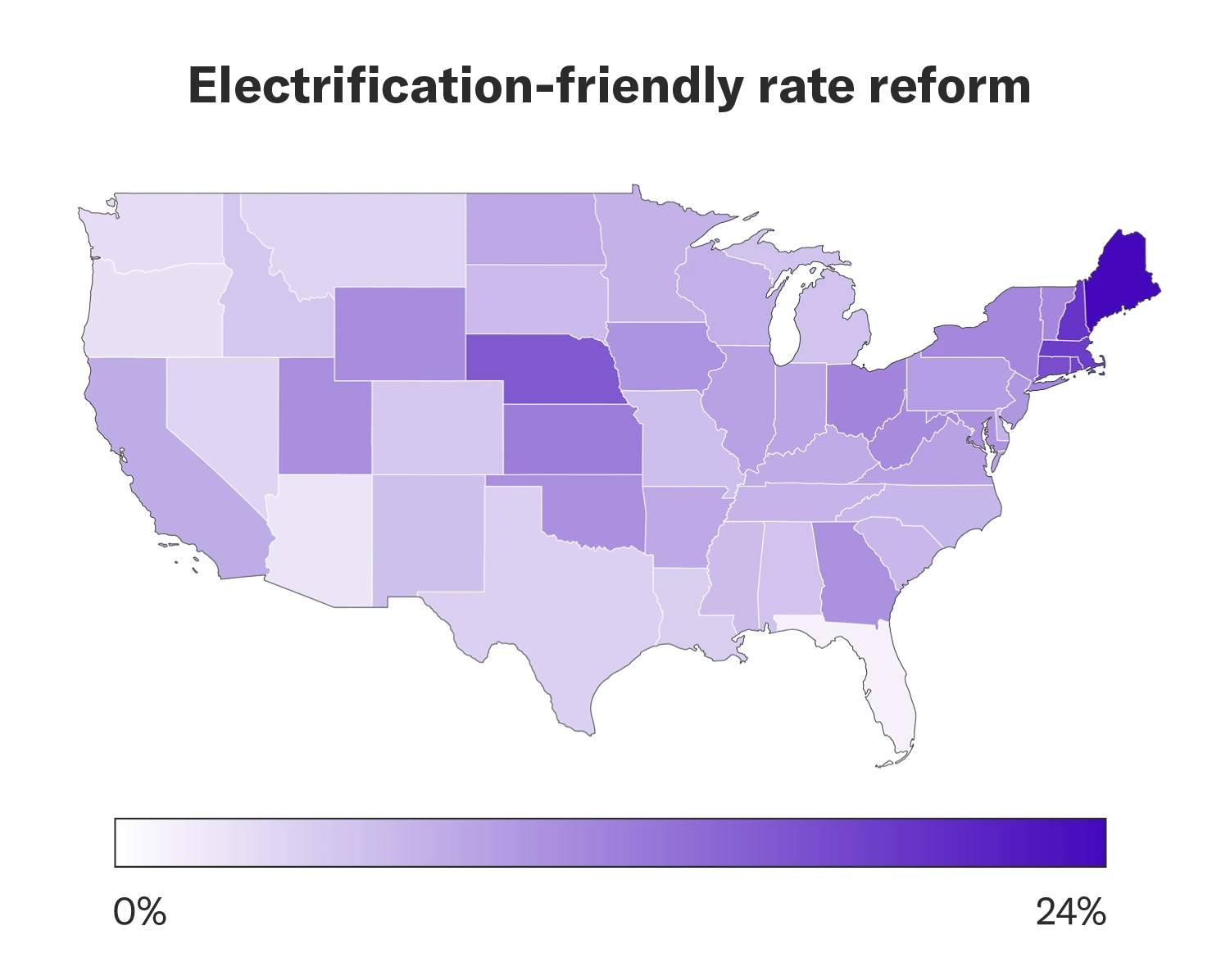
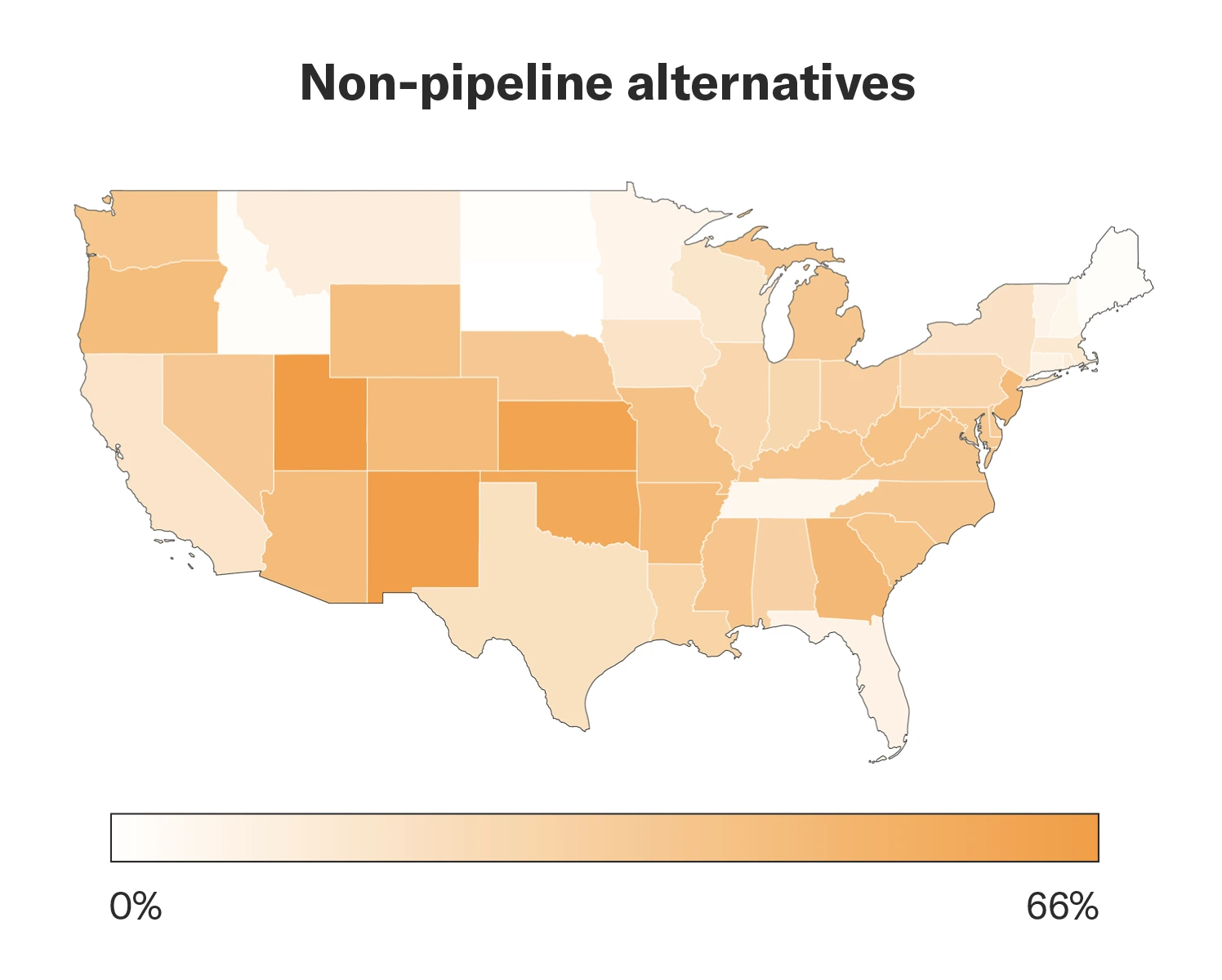
Data centers pay, inclusive utility investment, and non-pipeline alternatives impacts assume soft cost reductions have already been applied. Electrification-friendly rate reform impacts reflect affordability of whole-home electrification upgrade without solar or storage.
The sections that follow begin with how these policies operate as a coordinated portfolio, demonstrating how their combined effects unlock affordability at scale. We then explore each policy individually, including modeled impacts, design considerations, real-world examples, and political feasibility.

Aligning policies to deliver for households
The real power of these policies lies in how they work together. By aligning adoption, savings, and system value, they do more than stack benefits — they reinforce one another, creating a virtuous cycle that expands affordability over time.
The following state examples illustrate how combining policies produces compounding effects, where the total impact exceeds the sum of its parts.
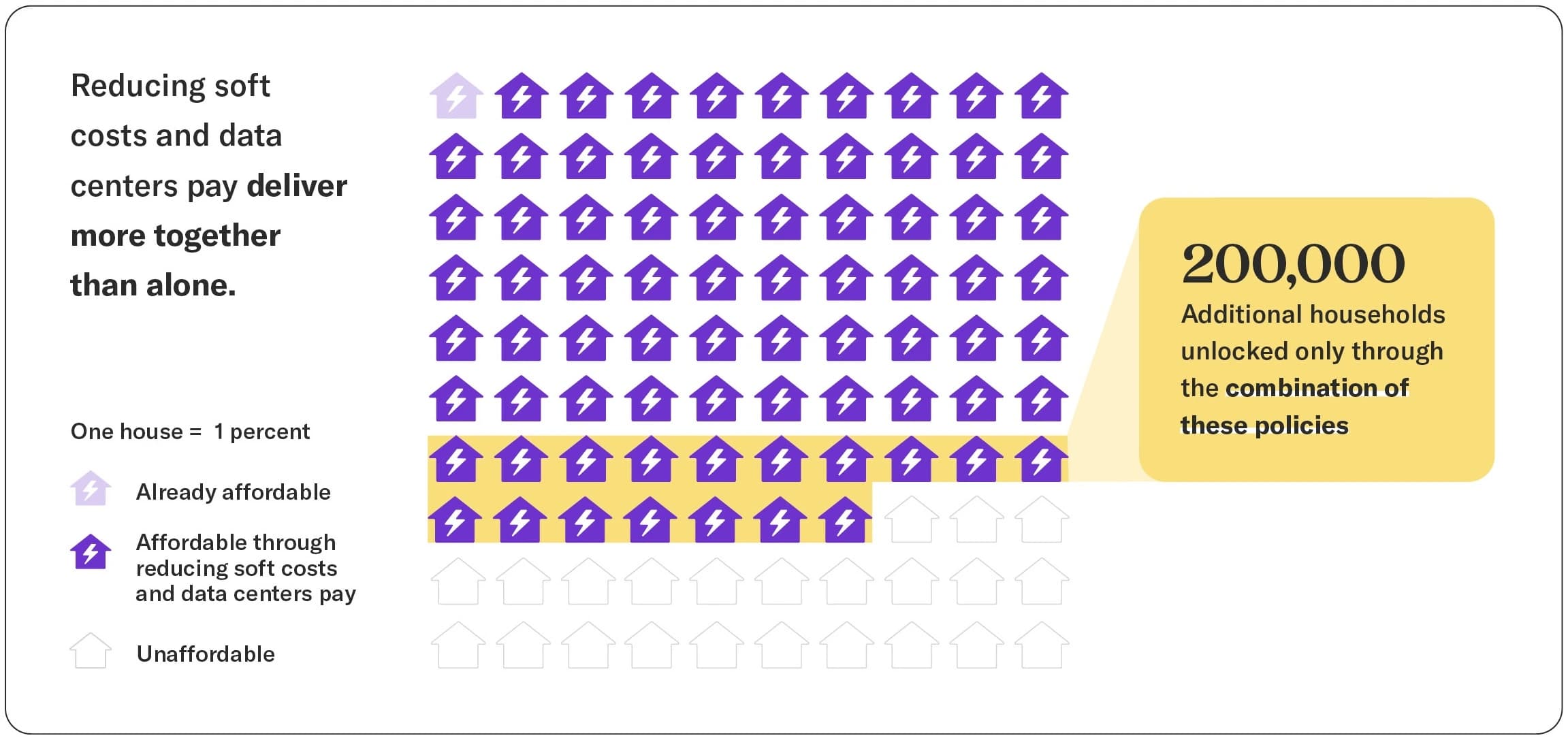
Arizona: Reducing soft costs and data centers pay
In Arizona, baseline affordability for home energy upgrades is just 1 percent of households, reflecting both limited access to capital and high upfront costs. Incentivizing data centers to invest in households introduces a significant new source of funding, increasing affordability to 39 percent. Reducing red tape alone increases affordability to 22 percent by lowering installation costs.
Together, these policies combine to deliver an outsized impact. By allowing each dollar of data center investment to reach more households, they increase affordability from 1 percent to 77 percent — tipping 900,000 households into affordability and delivering average lifetime savings of $14,000 per household. This example underscores why reducing soft costs is foundational: it increases the effectiveness of every other investment, a dynamic reflected throughout this analysis.
Illinois: Non-pipeline alternatives and inclusive utility investment
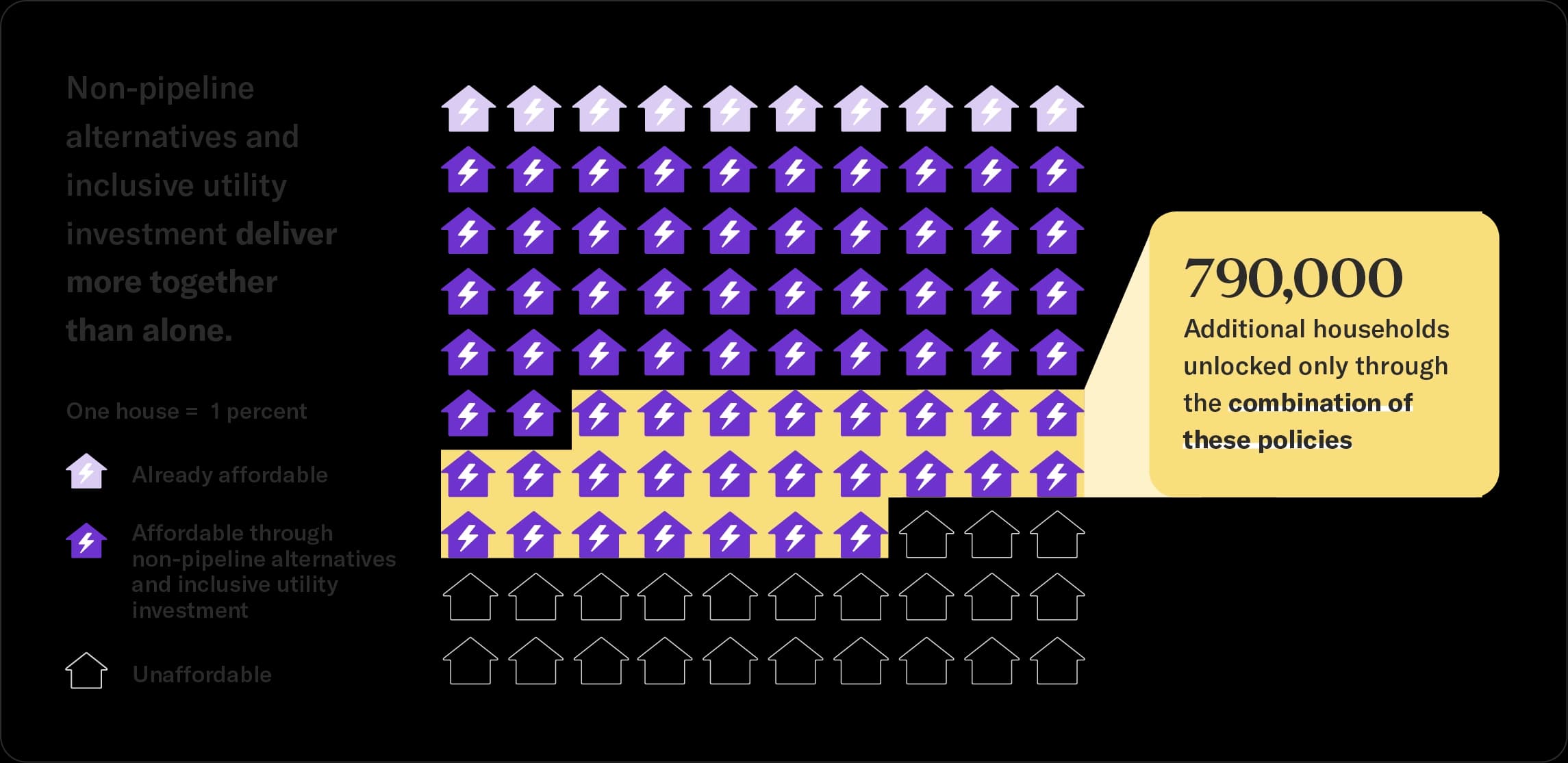
In Illinois, baseline affordability for home energy upgrades is 10 percent of households. Non-pipeline alternatives increase affordability to 38 percent by avoiding costly gas infrastructure and redirecting that capital toward electrification. Inclusive utility investment, on the other hand, increases affordability to 24 percent by removing upfront cost barriers through utility-backed financial solutions. Together, these policies reinforce each other: avoided infrastructure spending provides a source of capital, while inclusive utility investment ensures it can be deployed at scale to households. They combine to increase affordability from 10 percent to 77 percent — tipping 2.1 million households into affordability and unlocking average lifetime savings of $9,500 per household.*
*Assumes soft cost reductions have already been applied.
Texas: Data centers pay and inclusive utility investment
Texas is expected to see 50 GW of data center demand growth over the next five years — but a substantial amount of that demand can be met through investment in households.6 Upgrading the state’s 4.5 million homes that use central air conditioners to heat pumps could unlock 4 GW of capacity, or about 8 percent of projected demand. Adding solar and storage unlocks an additional 14 GW. Together, these residential solutions could meet roughly 30 percent of expected new data center demand in the state.7
Texas can capture this opportunity by directing data center investment into home energy upgrades, which would increase the affordability of such upgrades from a baseline of 3 percent to 40 percent of households. At the same time, inclusive utility investment could deliver those upgrades with low- or no upfront cost, increasing affordability to 19 percent.
Together, these policies combine to deliver impacts greater than the sum of their parts. They increase affordability from 3 percent to 69 percent — bringing 3.6 million households into reach and unlocking average lifetime savings of $13,000 per household.*
*Assumes soft cost reductions have already been applied.
Policies in focus
Reducing soft costs
Reducing soft costs is a foundational policy intervention that applies across geographies and technologies. By lowering the total cost of upgrades, it improves the performance of every other policy. As such, we treat soft cost reductions as a baseline condition and model the impacts of all other policies on top of a system where these costs have already been reduced.
American families pay far more than necessary for rooftop solar, battery storage, and heat pumps due to permitting delays, inconsistent local requirements, duplicative inspections, and slow interconnection processes. Typical solar installation costs are around $4 per watt in the U.S., while comparable countries have achieved costs at or below $1 per watt. The primary difference is not hardware — it is red tape.
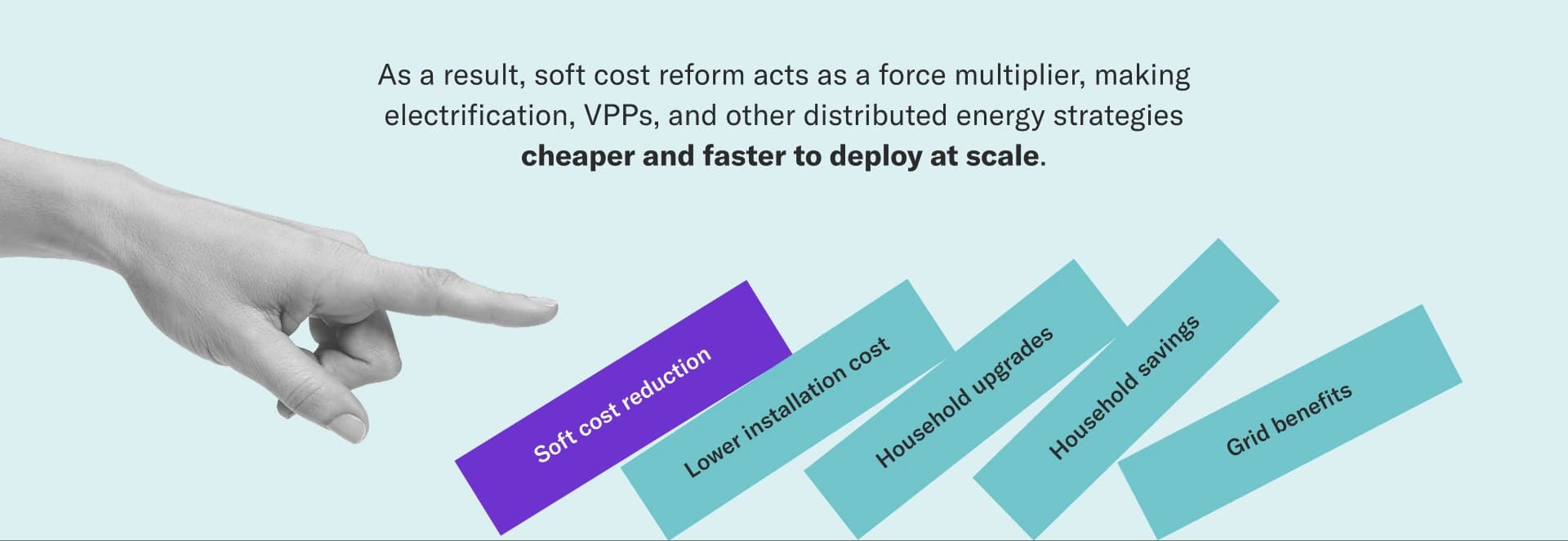
Soft cost reform standardizes permitting, inspection, and interconnection processes so that installing household energy technologies becomes faster, simpler, and more predictable across jurisdictions. Cutting unnecessary barriers is a powerful tool in our toolbox to allow new technologies to reach runaway adoption thresholds, allowing households and the market to drive rapid deployment without being held back by avoidable costs and delays.
We model a 40 percent reduction in the upfront cost of rooftop solar and battery storage across all eligible households.
Potential impact
Reducing soft costs would make home energy upgrades affordable for an additional 14 million households (increasing affordability from 9 to 30 percent of eligible households) — unlocking average lifetime savings of $9,300 per household.
Soft costs account for the majority of residential solar and storage pricing in the United States — estimated at between 64 and 78 percent of total installed cost in some analyses.8 Permitting and inspection alone can add roughly $1 per watt, or thousands of dollars, to a typical residential solar system.9 Adopting best practice permitting frameworks can reduce overall installed prices by up to half.10
For households, lower installation costs translate directly into bill savings. Rooftop solar can reduce annual energy costs by thousands of dollars, while storage can further reduce exposure to peak prices and outages.
At the system level, reducing soft costs accelerates deployment of distributed resources, lowering peak demand and relieving grid constraints.
Policy design
Soft cost reforms typically focus on modernizing permitting, inspection, and interconnection processes while maintaining safety and grid reliability standards. Statewide requirements are generally more effective than voluntary or incentive-based approaches in driving consistent adoption, though targeted funding and technical assistance can help local governments implement these changes.
Key policy levers include:
Instant, automated permitting for standard residential solar + storage (e.g., SolarAPP+ or equivalent)
Simplified and remote inspections for routine residential installations, including heat pumps
Third-party permitting and inspection for routine residential installations, including heat pumps
Permit fee caps and standardized permitting applications so fees and requirements are predictable across jurisdictions
Faster, more standardized interconnection (including clear timelines, automatic approvals for qualifying, export-limited systems, penalties for exceeding timelines, and the ability to install meter-collar adapters to avoid electrical panel upgrades)
Removing unnecessary local add-ons (e.g., duplicative engineering letters, bespoke documentation, avoidable hardware requirements)
Training contractors on automated processes
Policies should define clear standards for projects that are eligible for automated and streamlined approval, while preserving manual review for complex projects.
Examples
Throughout this resource we label examples “enacted” if a bill is signed into law, “adopted” if a PUC or administrative rule is in force, “active” if a program is actively being implemented, and “proposed” if a bill is introduced but not yet passed

New Jersey: A 5264/S 4100 (2025, enacted)
Minnesota: SF 4942/HF 5047 (2024, enacted)
Virginia: SB 382/HB395 (2026, enacted)
Many states are embracing automated permitting. New Jersey and Virginia require local governments to adopt a statewide automated permitting platform or an equivalent system. Minnesota took an earlier, incentive-based approach, offering grants and technical assistance to support local adoption of automated permitting tools.

California: SB 282 (2025, proposed)
The Heat Pump Access Act proposes streamlined permitting and remote inspection pathways for residential heat pump water heaters and HVAC systems, including capping permit fees and standardizing permitting checklists.

Texas: SB 1202/HB 1202 (2025, enacted)
Texas enacted legislation to allow licensed third-party engineers or building inspectors to permit and inspect home backup power systems, including home solar and storage projects. The third parties can use automated permitting systems and conduct inspections remotely.
Best when...
Reducing soft costs is broadly beneficial across geographies and technologies, improving the economics of home energy upgrades and amplifying the impact of other policies in nearly all contexts. It is especially impactful when:
High electricity rates create faster payback on rooftop solar, driving customer demand
Net metering or export compensation policies support distributed generation economics
Existing permitting and interconnection processes are cumbersome, fragmented, or slow
Political prospects
Soft cost reform is a political winner because it lowers prices without requiring new public spending. Cutting red tape and standardizing permitting also resonates across party lines and aligns a wide range of stakeholders, from consumer advocates and installers to legislators focused on affordability and economic growth.
Because it reduces costs while accelerating deployment of resources that can relieve pressure on the grid, soft cost reform can also be framed as a pragmatic strategy to manage load growth without increasing ratepayer costs.
Data centers pay
Data centers are projected to add more than 100 GW of new electricity demand by 2030,11 equivalent to the power needs of approximately 70 million homes. Meeting that demand through traditional infrastructure alone would require hundreds of billions of dollars in new generation, transmission, and distribution upgrades, increasing costs that are ultimately borne by households.
Policymakers are rightly focused on ensuring that new large loads pay for the infrastructure they require. But preventing cost-shifting is not the same as delivering public benefit. Approaches focused solely on cost allocation can limit risk to existing customers but do little to reduce overall system costs, accelerate deployment timelines, or lower household energy bills.
A Homegrown Energy approach builds on these baseline guardrails by directing hyperscale investment toward distributed energy resources that strengthen the grid and deliver tangible benefits to households. These resources can be deployed in months rather than years, providing faster capacity relief while reducing reliance on expensive infrastructure expansion.
Structured properly, this approach converts the rapid growth of AI infrastructure into a major source of private capital for household energy upgrades. Hyperscalers fund distributed energy investments that create measurable capacity on the grid and, in return, receive credit for that capacity along with faster, more certain speed to power.
Our original Homegrown Energy report, released in fall 2025, showed that home energy upgrades could unlock more than enough capacity to meet all projected new data center demand. The constraint is not technical potential, but policy design and investment alignment.
We model a 50 percent reduction in the upfront cost of whole-home electrification for households that currently use electric resistance heating, and a 30 percent reduction in the upfront cost of rooftop solar and battery storage for all eligible households. We assume soft cost reductions have already been applied.
Potential impact
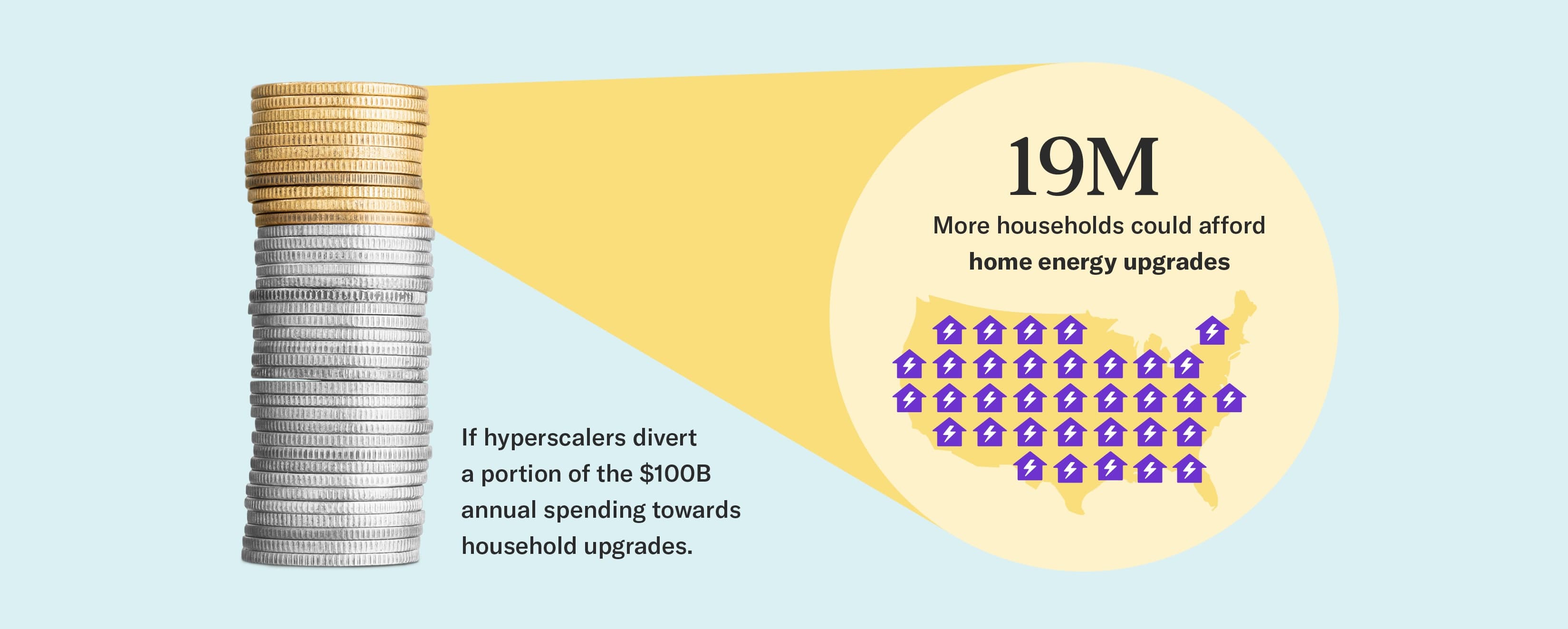
Hyperscalers are driving more than $100 billion per year into energy generation and infrastructure investment.12 Directing even a portion of that spending toward distributed energy resources could mobilize tens of billions of dollars for household energy upgrades.
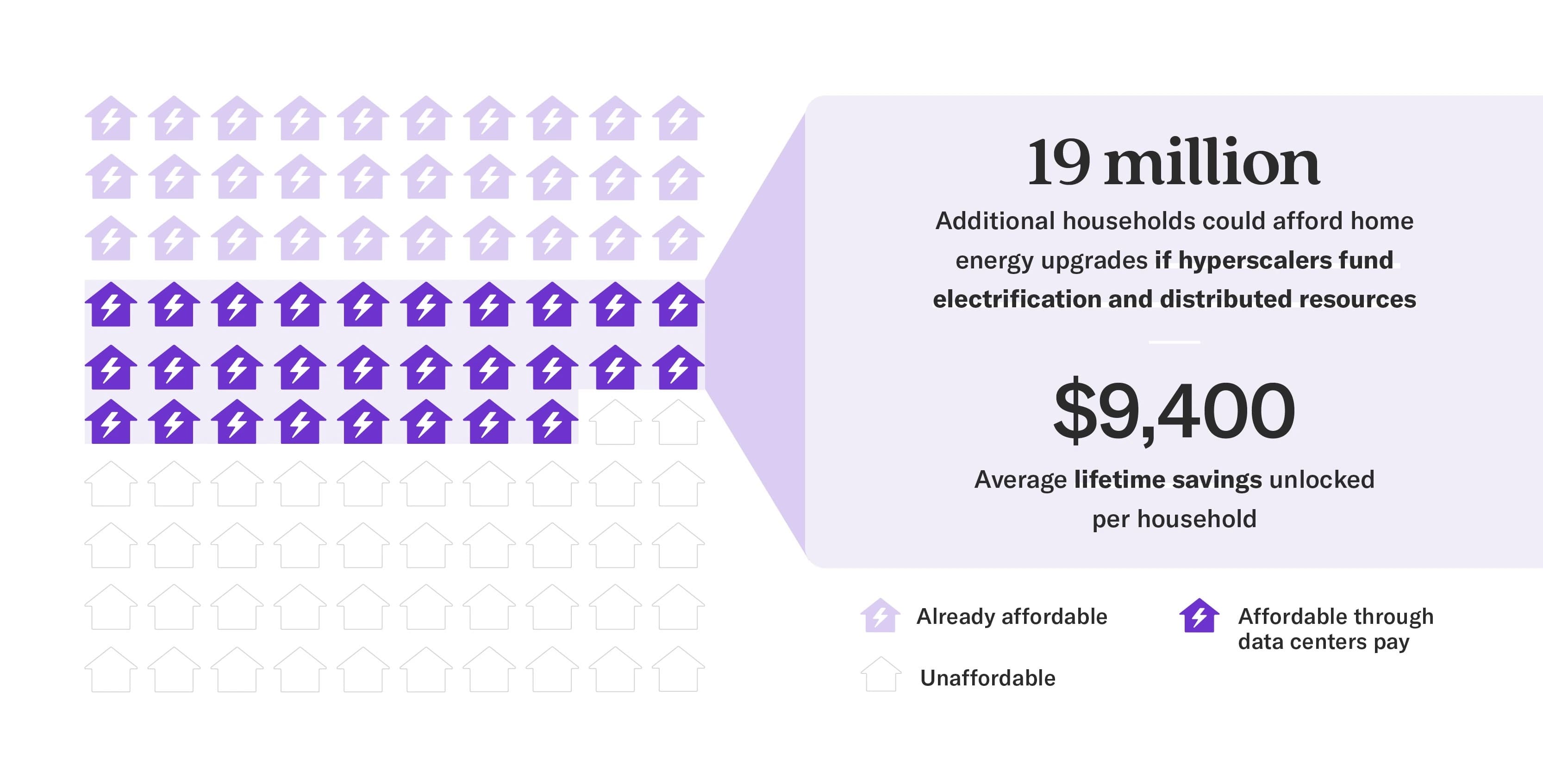
Hyperscaler investment in home energy upgrades would make such upgrades affordable for an additional 19 million households (increasing affordability from 30 to 58 percent of eligible households) — unlocking average lifetime savings of $9,400 per household.
Distributed resources can also lower the system costs of data center growth by 20–40 percent, putting downward pressure on electricity prices for all customers.13
Policy design
There is emerging consensus that new data centers should, at a minimum, meet their own energy needs. A Homegrown Energy framework goes further by pairing clear targets with strong, incentive-backed pathways that direct hyperscaler investment toward distributed capacity.
States can begin by setting clear goals for how new demand will be met. For example, states could aim to:
Meet at least half of new data center electricity demand through distributed resources, including household, community, and commercial programs.
Direct a substantial portion of that investment (e.g., ~25 percent of total capacity) toward household upgrades, including weatherization, energy-efficient electrification, solar, and storage.
Critically, state targets should be paired with incentives that align private investment with public outcomes. The most effective lever is speed to power: states can offer faster, more certain interconnection pathways for data centers whose developers invest in distributed capacity and deliver measurable system benefits. This creates a clear “high-road” pathway for hyperscalers — where investments in households and communities translate directly into faster project delivery and reduced development risk.
To operationalize this framework, states can build on emerging policy tools:
Large-load tariffs: Large-load tariffs provide a foundation to protect consumers and limit system risks.14 But they can expand to serve as the primary incentive mechanism to link faster, more certain speed to power with investments in distributed resources and household upgrades.
Bring your own distributed capacity (BYODC)15 and clean transition tariffs: States can pair large-load tariffs with tools that enable hyperscalers to directly meet distributed capacity targets. This includes structures like BYODC and clean transition tariffs, which allow large customers to fund or procure incremental portfolios of distributed resources — either through third-party aggregators or in partnership with utilities.
System benefit charges: Complementary mechanisms, such as non-bypassable peak-demand-based charges, can ensure a baseline level of investment in distributed energy programs, particularly for low-income households. These charges create a durable funding stream for affordability investments, while preserving flexibility for hyperscalers to meet broader distributed capacity goals through direct investment.
Realizing the full value of this approach requires ensuring that distributed resources are properly valued and enabled. These recommendations are discussed in more detail in the virtual power plants section of this report.
Examples

New York: A 9297 (2026, proposed)
New York’s proposed Homegrown Energy Act would require data center developers to offset a portion of their electricity use by funding residential energy upgrades, including heat pumps, rooftop solar, and battery storage. These investments would be administered through a state-managed program and targeted toward households with the greatest need.

Illinois: SB 4103/HB 5513 (2026, proposed)
Illinois’ proposed POWER Act would establish large-load tariffs, require data centers to bring new clean capacity or reduce load during peak periods, and offer faster interconnection for projects that meet more ambitious thresholds over time. It also explicitly allows distributed resources to count toward compliance. Building on this strong foundation, states should ensure distributed resources are not just eligible, but incorporated into the requirements of the “high-road” pathway for faster, more certain interconnection.

Minnesota: HF 16/SF 19 (2025, enacted)
Illinois: SB 4103/HB 5513 (2026, proposed)
Washington: HB 2515/SB 6171 (2026, proposed)
Wisconsin: LRB 5432 (2025, proposed)
Several states are exploring peak-demand-based fees on hyperscale facilities to fund energy affordability and grid modernization programs. Minnesota enacted legislation requiring large data centers to pay annual fees of $2–$5 million to support low-income efficiency upgrades, and Illinois’ proposed POWER Act includes similar fees of $2–$12 million. Proposals in Washington and Wisconsin take similar approaches. These policies establish an important baseline, but their scale is modest. By comparison, compensating distributed resources at the equivalent cost of new capacity would unlock significantly greater investment and system value. Fully capturing that opportunity will require pairing these fees with larger, market-based pathways that direct capital into distributed capacity at scale.

Minnesota: Google–Xcel Energy clean transition tariff (2026, proposed)
A recent agreement between Google and Xcel Energy demonstrates how hyperscalers can fund distributed resources through utility tariff structures. Under the proposed arrangement, Google will fund a $50 million expansion of Xcel’s Capacity*Connect program, deploying distributed batteries to relieve grid constraints and defer infrastructure upgrades. Although this investment was negotiated directly between the utility and customer rather than mandated by state legislation, it illustrates the kinds of mechanisms that states could encourage or require.
Best when...
Policies that direct hyperscale investment toward distributed energy resources are most effective when several enabling conditions are present:
Rapid large-load growth from hyperscale data centers
Untapped distributed capacity potential (e.g., widespread electric resistance heating, inefficient building stock, or limited adoption of demand flexibility technologies that could deliver large peak reductions)
Grid congestion or long interconnection queues, where traditional generation or transmission projects face long permitting timelines and distributed resources can provide faster relief
Political prospects
Requiring hyperscalers to pay their own way already has broad political support. Directing that investment toward distributed resources turns a defensive posture into an affirmative one: delivering visible benefits for households and communities, lowering system costs for the grid, and enabling faster, more certain interconnection for data centers.
Inclusive utility investment
High upfront costs are one of the greatest obstacles to households adopting efficiency and electrification upgrades. Even though upgrades can deliver long-term energy savings, households often cannot afford the upfront cost, lack access to credit, or do not want to take on debt.
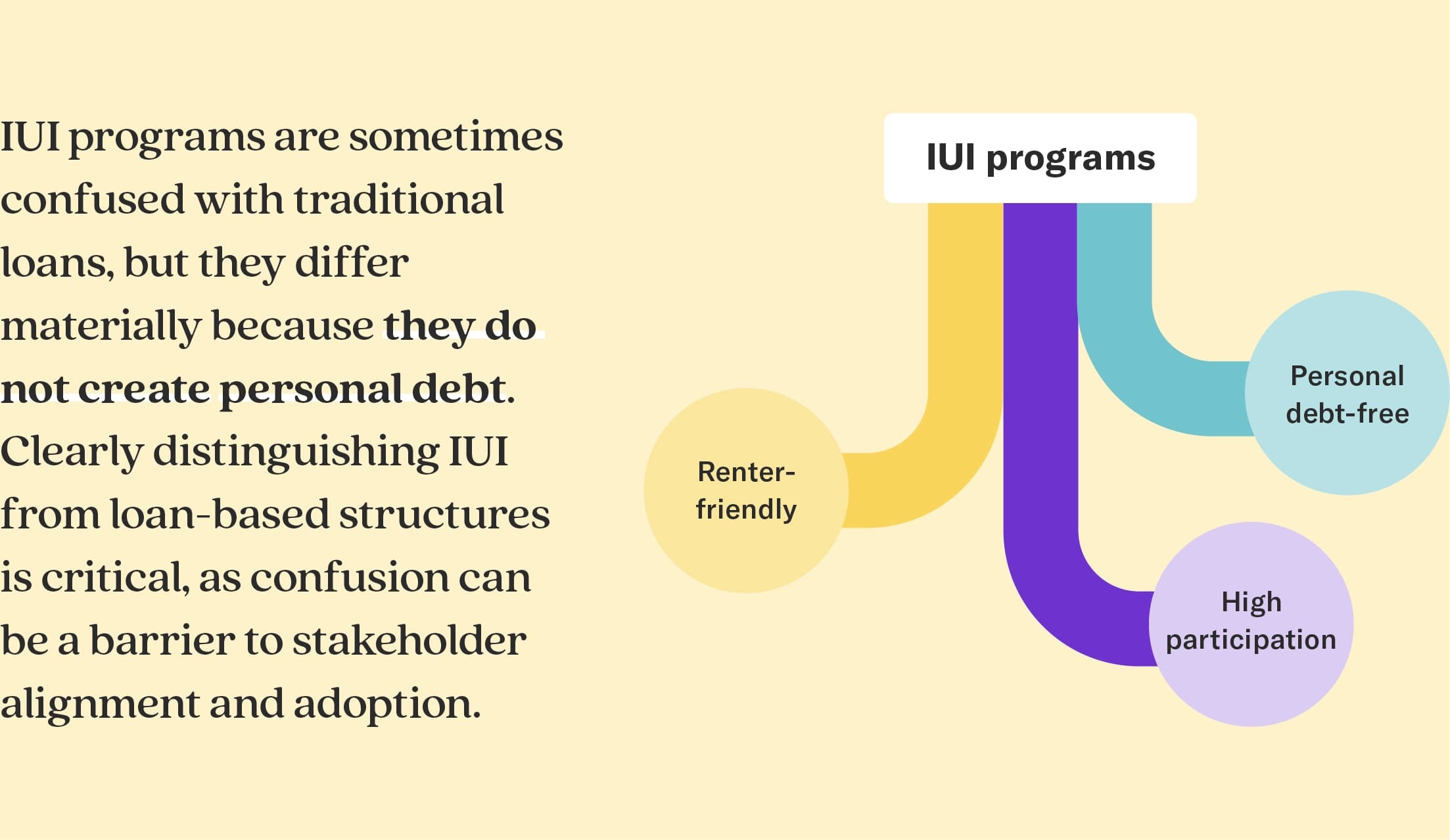
Inclusive utility investment (IUI) addresses this challenge by enabling the upfront cost of a household improvement to be paid for by the utility, and recovered over time through a site-specific charge on the utility bill. Because payments are tied to the location rather than the individual customer, costs can be recovered through energy savings over time rather than through personal debt.
Energy audits and calibrated modeling help ensure that projected bill savings exceed the cost-recovery charge so that participating households see immediate net bill reductions. Project eligibility is based on cost-effectiveness rather than an individual’s credit score or income.
In this way, IUI not only removes upfront cost barriers — it creates a scalable pathway to direct capital into household energy resources that reduce demand, provide flexible capacity, and lower system costs in a time of rapid load growth.
We model utilities covering the upfront costs of home energy upgrades across homes with expected operational savings and recovering costs over 15 to 20 years at a 4 percent rate. Cost recovery is capped at 80 percent of estimated savings to ensure households are not exposed to bill increases if expected savings fall short. We assume soft cost reductions have already been applied.
Potential impact
IUI programs create a mechanism for directing large-scale capital into household infrastructure: utilities, green banks, and federal programs can provide capital while the tariff provides predictable cost recovery.
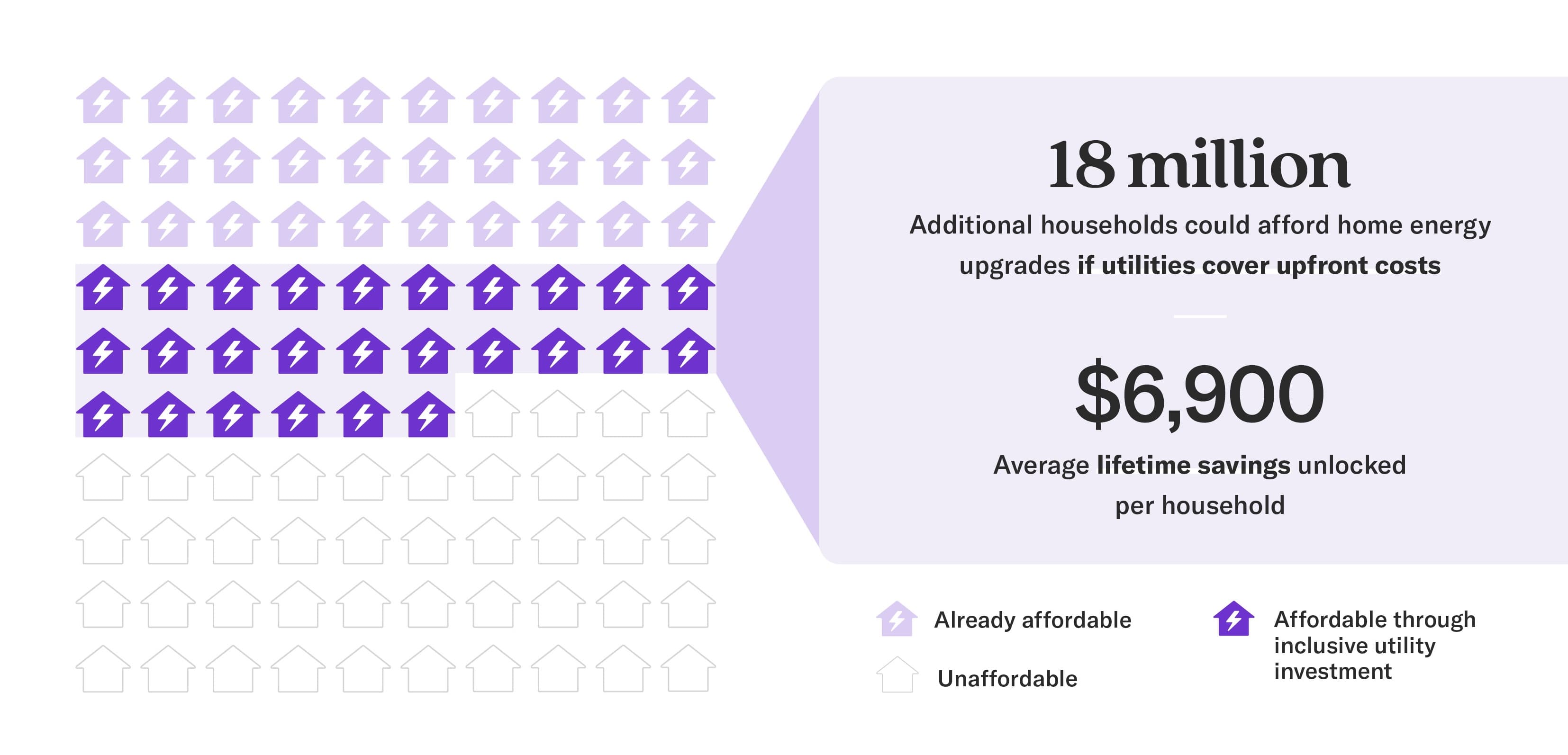
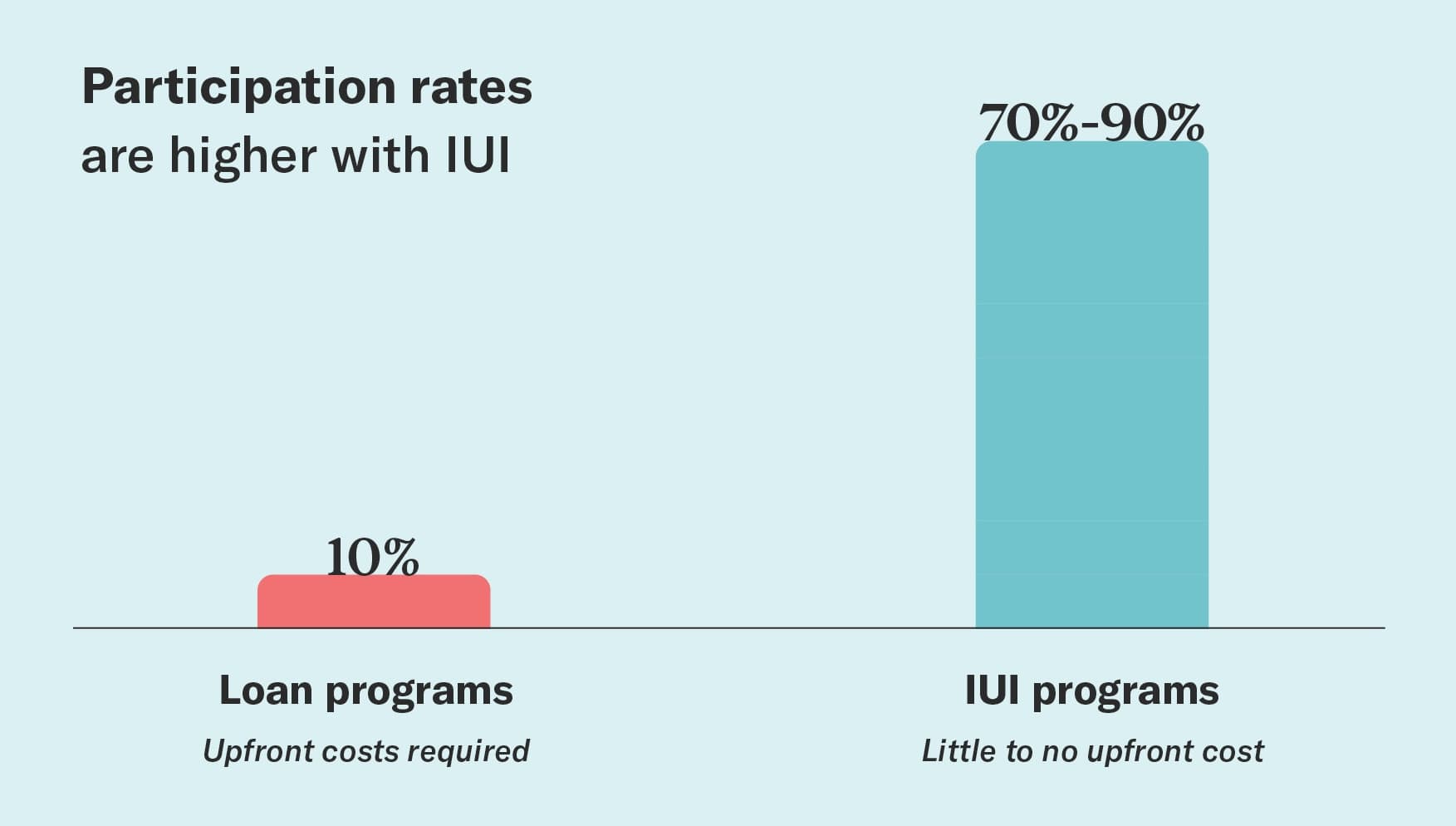
By allowing more customers to access low-upfront-cost capital for home energy upgrades, inclusive utility investment programs would make such upgrades affordable for an additional 18 million American households (increasing affordability from 30 to 56 percent of eligible households) — unlocking average lifetime savings of $6,900 per household. Field experience shows that when households face little to no upfront cost, participation rates can reach 70–90 percent compared with less than 10 percent for loan programs.16
Because the tariff-based charge is tied to the location rather than any individual person, renters can participate with property owner consent and landlords face no upfront costs — expanding access while overcoming persistent barriers.
At scale, this model enables utilities and policymakers to shift investment away from traditional infrastructure and toward customer-sited resources — turning household upgrades into assets that reduce system costs while improving affordability.
Policy design
Successful IUI programs are dependent upon clear regulatory authority and strong consumer protections. Well-designed programs allow utilities to deploy capital for household upgrades while ensuring that customers benefit financially from the improvements.
Key design features include:
Authorizing tariff-based cost recovery: State regulators must approve a tariff for utilities to make site-specific investments in household upgrades with cost recovery tied to the service at the location. This authority enables utilities to support efficiency and electrification upgrades in homes while recovering costs through the utility bill over time.
Consumer protection safeguards: Well-designed IUI programs embed strong consumer protections,17 including plain-language disclosures and informed consent; calibrated energy modeling18 to ensure bill savings exceed the tariff charge; cost-effectiveness screening at the project level; independent quality assurance and bill monitoring; remediation mechanisms and reserve funds for underperformance; and income-eligibility screening prior to enrollment.19
Stacking incentives and public funding. Because these programs are utility-administered, they can also smoothly integrate with existing rebate programs, weatherization funds, contractor networks, and quality assurance systems.
Integration with utility programs and contractor networks. Leveraging existing efficiency and electrification delivery infrastructure can accelerate program rollout and reduce administrative costs.
Make sure all resource savings are counted. IUI programs should count all savings generated by the upgrades, on both the gas and electric side, since energy efficiency upgrades can lower both electricity use and heating costs. This is also essential to enable fuel switching.
Examples

Massachusetts: Reinvest Ipswich (2023, active)
In 2023, with funding from Massachusetts Clean Energy Center, Ipswich Electric Light Department in partnership with Center for EcoTechnology (CET) launched an IUI pilot program for whole-home decarbonization. Participants experienced significant reductions in upfront costs, averaging 84 percent, and saw average energy bill savings of ~20 percent compared to historical costs.20
Illinois: SB 2408/HB 3624 (2021, enacted)
The Equitable Energy Upgrade Program in Illinois, established by the Climate and Equitable Jobs Act (CEJA) of 2021, directed the Illinois Commerce Commission to develop and require all large electric utilities to implement a framework modeled after the Pay As You Save program.

North Carolina: Upgrade to $ave Program (2025, active)
North Carolina’s Clean Energy Plan called for a Pay As You Save style program. Roanoke Electric Co-op saw program participation reach more than 10 percent of residential customers, who saw annual savings of roughly $600 per residence following upgrades.21

California: Decision 25-12-021 (2025, active)
The Public Utilities Commission recently approved an IUI pilot for Southern California Edison, representing a significant step in implementing the model within a large investor-owned utility territory.
Best when...
Inclusive utility investment is often most helpful in states or localities with:
Existing rebates that can be layered with IUI to improve project economics, lowering or eliminating any upfront copayment and shortening the cost recovery period
A high prevalence of households that would see meaningful bill savings from electrification (e.g., areas with significant electric resistance heating)
Clear access gaps in existing efficiency and electrification programs — particularly in renter-heavy or low-income communities — where IUI can expand participation, provided strong consumer protections are in place
Political prospects
Municipal utilities and electric cooperatives have led early adoption of IUI programs. Investor-owned utilities may require clear authority to earn a regulated return on capital deployed through these programs, which public utility commissions can enable through rate case decisions or explicit policy direction.
IUI programs can be politically durable because they expand access to home upgrades without requiring households to take on personal debt. However, concerns from consumer advocates — particularly around bill neutrality and risk exposure — must be addressed through strong consumer protections. Affordable housing advocates and multifamily property owners are often strong supporters, given IUI’s ability to overcome persistent participation barriers in renter-heavy communities.22
Electrification-friendly rate reform
Default residential electricity rates have largely maintained the same structure for decades, despite major changes in how electricity is produced and consumed.
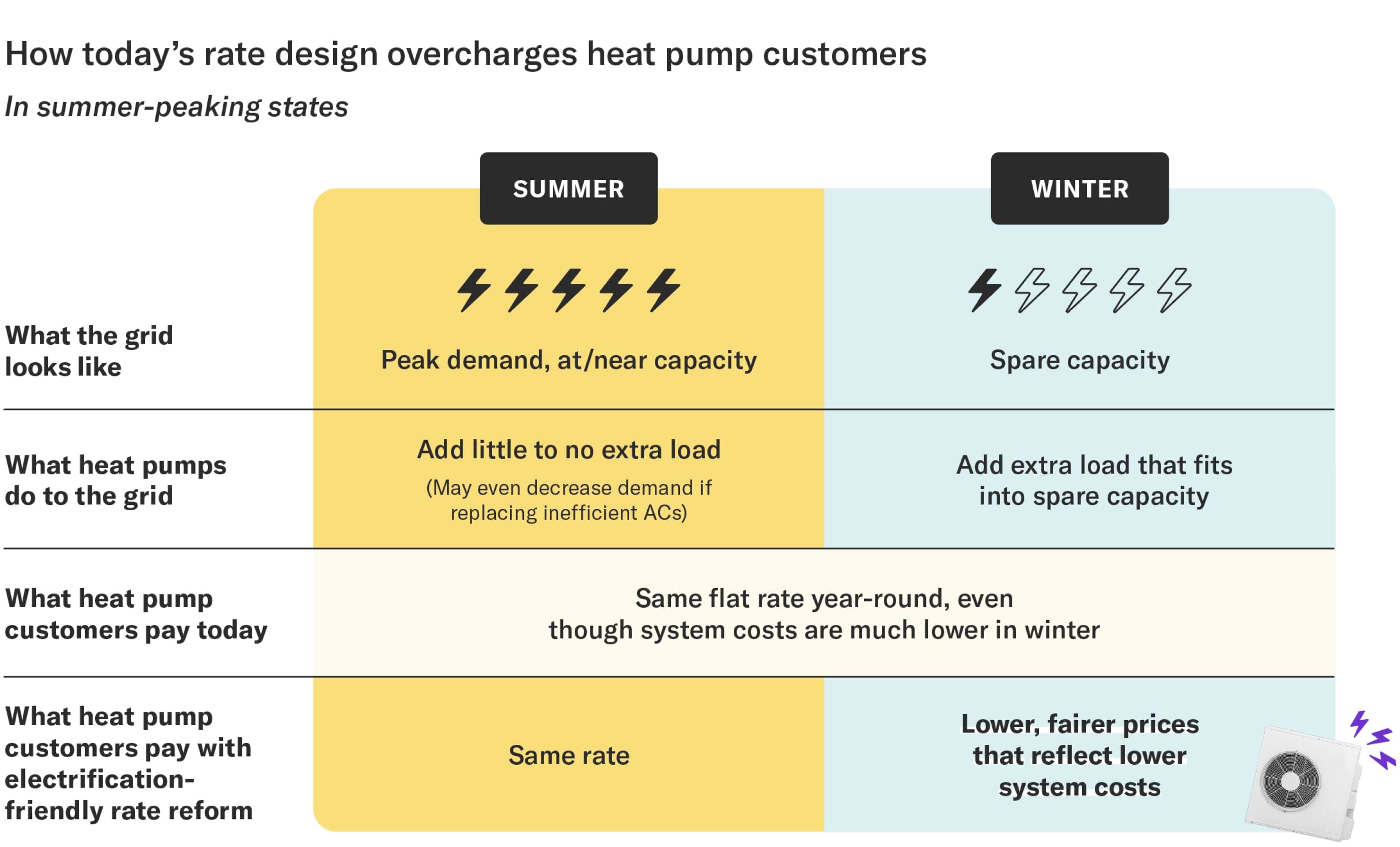
Under typical default rates, households pay a flat price per kilowatt-hour regardless of when electricity is consumed — day or night, summer or winter. When a household switches from a gas furnace to an electric heat pump, its annual electricity consumption rises, particularly during the winter heating season. However, most U.S. electric systems are summer-peaking, meaning infrastructure costs are driven largely by summer demand rather than winter load. During the winter, when system demand is lower, the grid often has substantial unused capacity that can accommodate additional heat pump load with little or no additional system cost.23
Flat volumetric rates fail to reflect this reality. As a result, heat pump households often pay higher winter bills even though their additional electricity use is not driving significant new system costs.
Heat pump-friendly rate designs correct this mismatch by aligning prices with underlying system costs. This can reduce annual bills by hundreds of dollars, often bringing heat pumps to cost parity or better with gas.
We model a 20 percent reduction in heat pump operating costs for space heating, assuming soft cost reductions have already been applied. This reflects a representative outcome achievable through electrification-friendly rate design, though the specific mechanisms to deliver these savings will vary by region based on system conditions.
Potential impact
Rate reform is one of the most direct ways to lower the day-to-day cost of running an electrified home. Because it primarily affects the operating cost of electric appliances, this analysis focuses on electrification alone, rather than the full upgrade package used in the other policy scenarios.
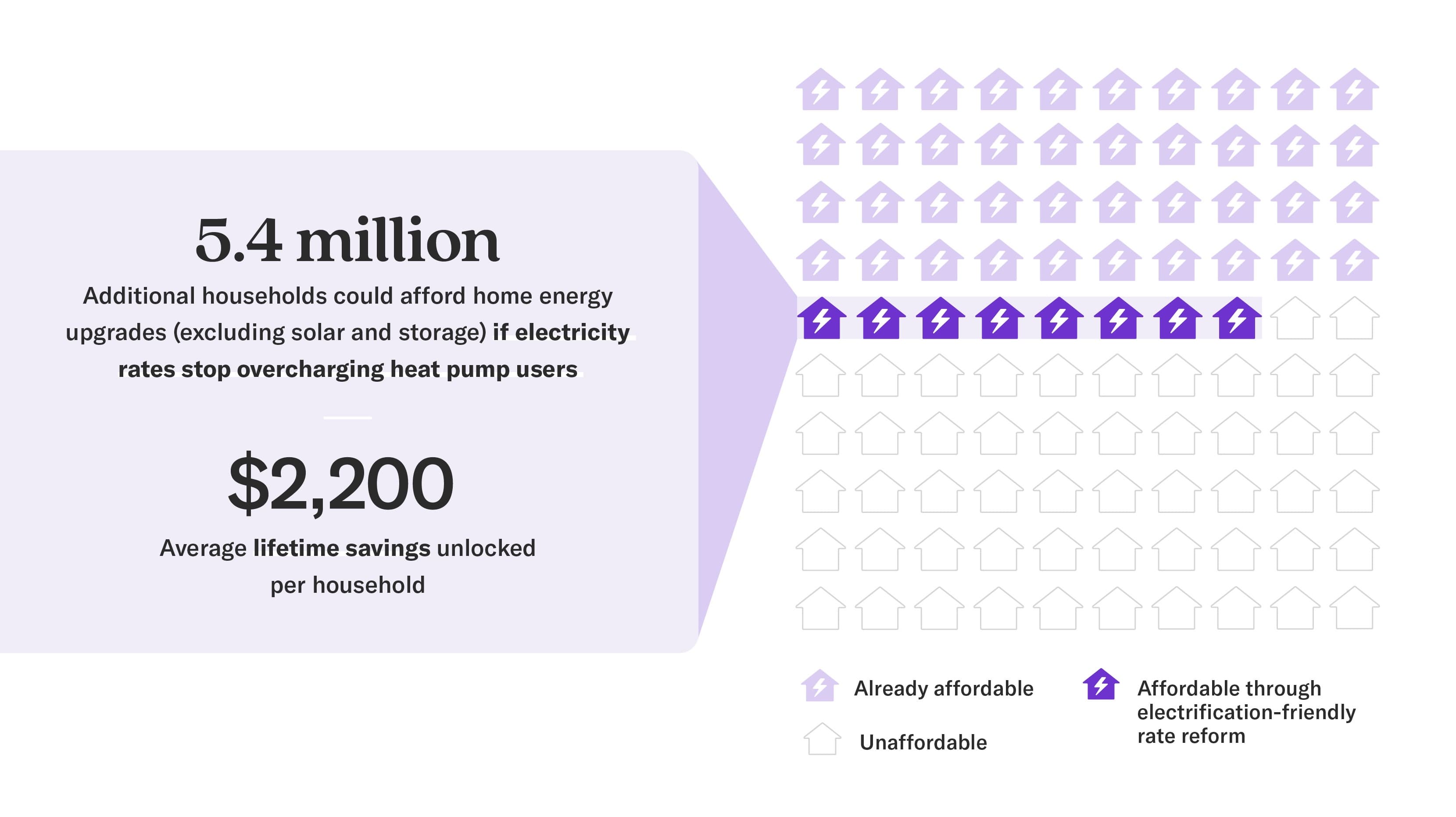
Under typical flat rates, heat pump households can be overcharged relative to their cost of service — in some cases by as much as $1,100 per year.24 By correcting this mismatch, modern rate design can make whole-home electrification affordable for an additional 5.4 million American households (increasing affordability from 40 to 48 percent of eligible households) — unlocking average lifetime savings of $2,200 per household. This analysis excludes solar and storage, whose higher upfront costs dominate total economics and therefore limit the impact of rate design on overall affordability.
Flexible, time-varying rates also enable virtual power plants by creating price signals that encourage households to shift usage and participate in coordinated demand response. When aggregated at the system level, these effects reduce peak demand and the need for new peaker plants and grid infrastructure — helping contain long-term costs for all ratepayers.
Policy design
Key rate design options to lower household and system costs include:
Seasonal heat pump rates, with lower prices during non-summer periods.
Time-of-use (TOU) rates, which charge higher prices during peak hours and lower prices off-peak, encouraging load shifting that reduces both customer bills and system costs.
Special rates for separately metered heat pumps or EVs, distinct from whole-home pricing.
Bill credits or bill protections that compensate customers when existing rate structures lead to overpayment.
Shifting cost recovery from volumetric charges to fixed charges, reducing the link between total consumption and monthly bills.
The appropriate rate design will depend on whether a system is summer- or winter-peaking, but the underlying goal is the same: aligning prices with system costs to reduce bills and improve system efficiency.
Heat pump-friendly rates can be implemented as default (opt-out) or optional (opt-in) offerings. Because these rates are designed to lower bills for electrified households, states and utilities should automatically enroll customers installing heat pumps so they reliably capture available savings.
Broader rate reforms — such as time-of-use pricing or other variable rate structures — can deliver additional system benefits but may require phased rollout, customer education, and protections for low-income and other vulnerable households to ensure equitable outcomes.
In all cases, successful deployment depends on clear communication and enrollment strategies. Personalized comparison tools can help households understand expected bill impacts and support informed participation.
Examples
Massachusetts: Docket #25-08 (2025, active)
The Massachusetts Department of Public Utilities (DPU) required each electric investor-owned utility to implement heat pump rates with seasonal discounts. To increase participation, utilities are directly enrolling customers who receive heat pump rebates through Mass Save into these rates. Customers on the new rates are estimated to have saved at least $37 million during the first heating season (averaging $250 in savings per participating household), and the DPU is currently considering proposals for even deeper seasonal discounts in future years.25

Michigan: Docket U-21684 (2025, active)
As part of its biennial Energy Waste Reduction plan filing, Upper Peninsula Power Company proposed modifications to existing electric heating rate structures to support its electrification programs, including seasonally differentiated volumetric rates and an optional time-of-use rate. This approach illustrates how existing rate designs can be adapted to better support electrified heating while improving affordability and grid responsiveness.

Colorado: SB 24-214 (2024, enacted)
In implementing the state’s climate goals, Colorado required investor-owned utilities to propose voluntary heat pump rates by August 2027 and directed utilities to align rate design with electrification goals and affordability.
Best when...
Rate reform is especially effective when:
The electric system is summer-peaking and can accommodate additional winter load from heat pumps at low system cost
Although seasonal heat pump rates may not be applicable for winter-peaking systems, alternative rate structures like time-of-use pricing can achieve similar cost alignment and bill savingsDefault rates lack seasonal differentiation, leading to overpayment by heat pump customers whose increased usage occurs during lower-cost periods
Electricity prices are high relative to gas, increasing the importance of reducing operating costs to make electrification financially attractive
Advanced metering infrastructure is in place, enabling time-of-use and other time-varying rate designs and accurate measurement of customer usage patterns
Political prospects
Rate reform can raise concerns about administrative complexity and equity impacts, but both can be addressed through careful design.
Utility administrative concerns. Utilities often argue that new rate structures increase billing complexity and customer service burden. In practice, these challenges are manageable — especially for utilities that already offer multiple rate options or have advanced metering infrastructure and modern billing systems. Legislatures and regulators can further reduce friction by aligning implementation with scheduled rate cases and providing clear timelines and direction.
Equity and bill impact concerns. Consumer advocates often worry that time-varying rates could increase bills for low-income or vulnerable households with limited ability to shift usage. States can address this by pairing rate reform with strong affordability protections, such as discount rates or percentage-of-income payment plans, free or low-cost enabling technologies (e.g., smart thermostats), and temporary bill protections during the transition. Evidence from pilot programs shows that, with these safeguards, low- and moderate-income customers can achieve bill savings and peak reductions comparable to other households.26 Clear customer education, personalized rate comparison tools, and integration with electrification and IUI programs can further support equitable participation.
Non-pipeline alternatives
Gas utilities across the United States invest billions of dollars each year to maintain and expand the natural gas distribution system — replacing aging pipelines, expanding gas service, and reinforcing infrastructure to meet peak winter demand. These investments are made based on multi-decade forecasting and costs are recovered from customers’ rates, often locking in 30- to 50-year cost commitments even as gas demand declines and prices remain highly volatile.
Non-pipeline alternatives (NPAs) offer a different path. NPAs are strategies that defer, reduce, or eliminate the need for new or expanded gas system infrastructure.27 By electrifying and weatherizing homes served by a pipeline segment, or avoiding new gas connections, utilities can eliminate costly pipe replacement while lowering household energy bills and improving system efficiency. In a period of rising infrastructure costs and uncertain long-term gas demand, NPAs allow states to meet system needs while avoiding investments that risk becoming underutilized or stranded.
We model a 40 percent reduction in the upfront cost of whole-home electrification for households that currently use gas heating. We assume soft cost reductions have already been applied.
Potential impact
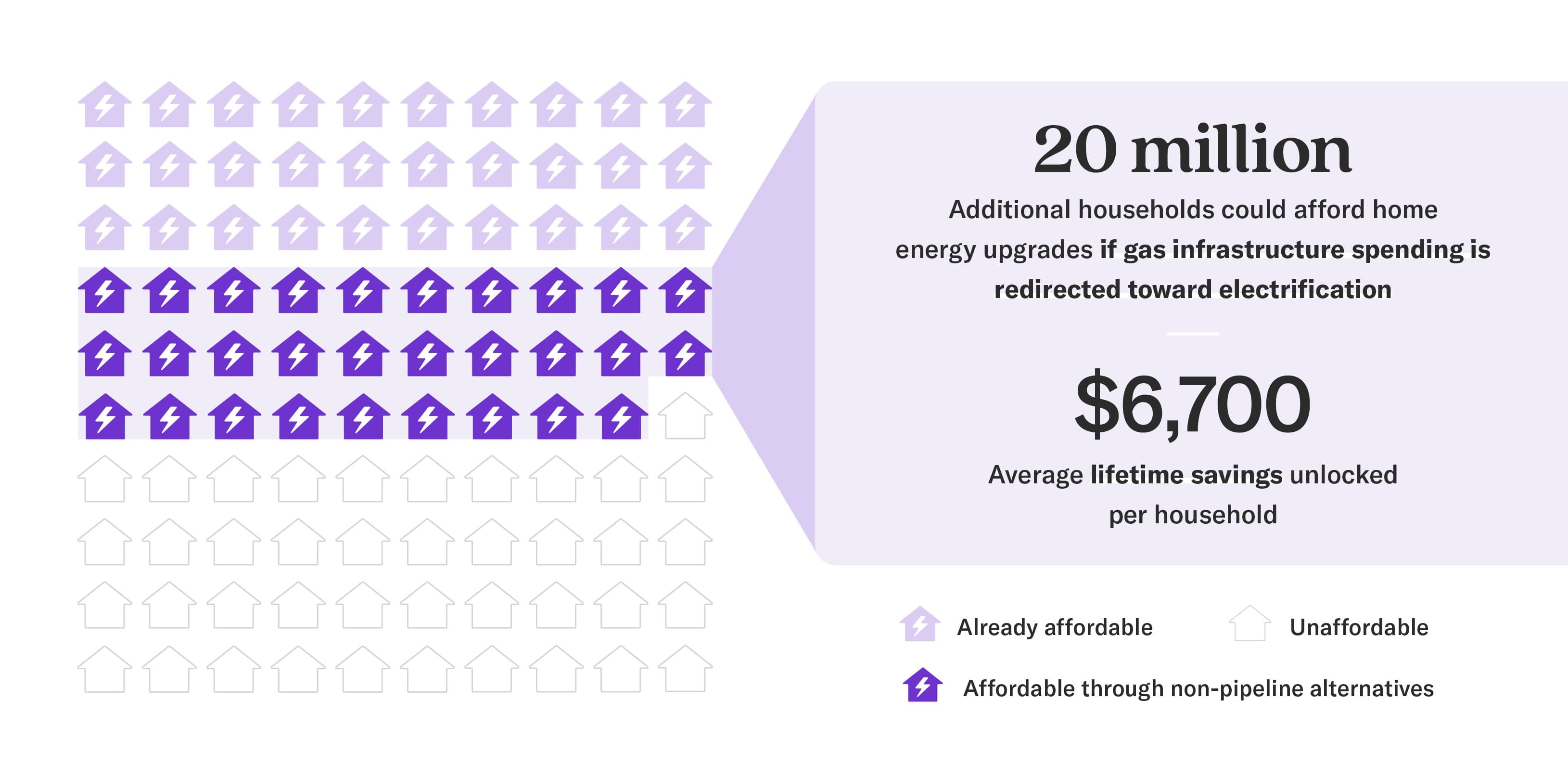
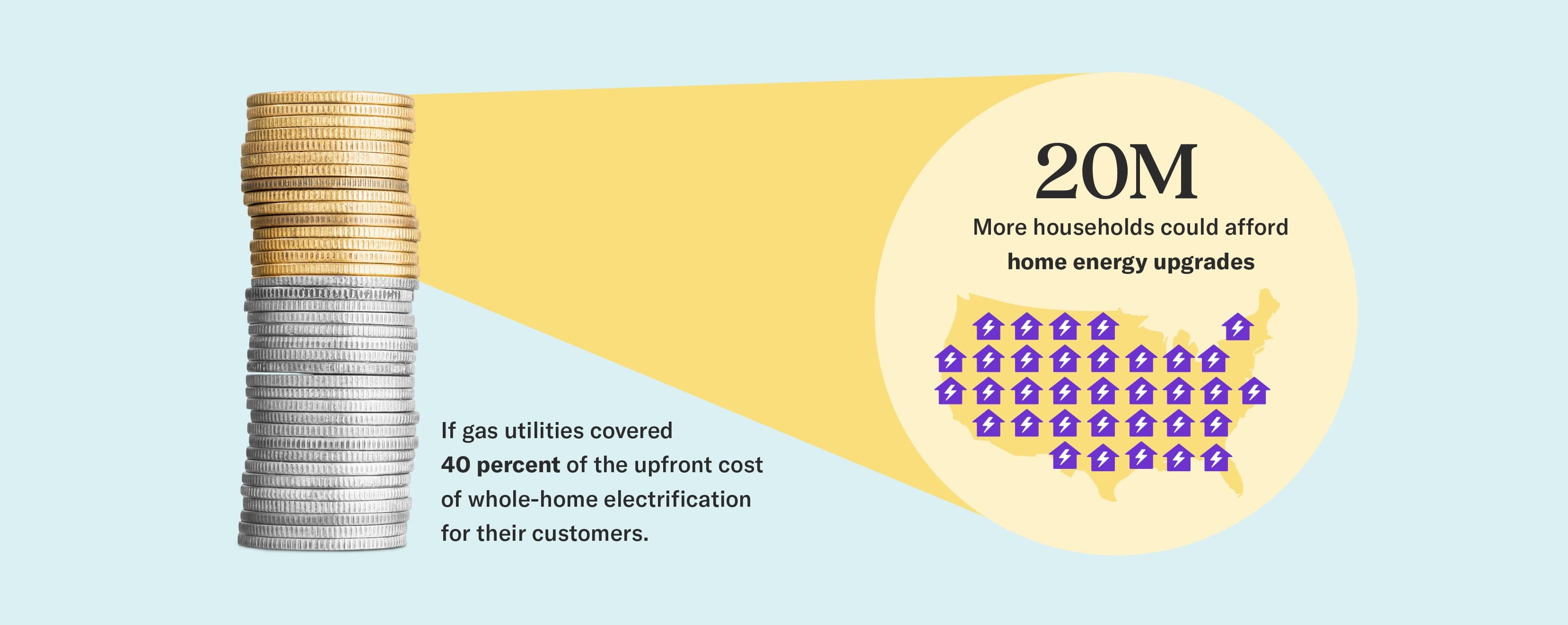
If gas utilities covered 40 percent of the upfront cost of whole-home electrification for their customers, these upgrades would become affordable for an additional 20 million households (increasing affordability from 30 to 59 percent of eligible households), unlocking average lifetime savings of $6,700 per household.
At the system level, redirecting gas infrastructure spending toward electrification can avoid or defer capital-intensive distribution upgrades, reduce peak gas demand and exposure to fuel price volatility, and limit stranded asset risk as demand declines. By avoiding unnecessary capital investment, these approaches reduce future additions to the rate base and help lower long-term costs for customers.
Policy design
Capturing NPA opportunities requires reforming how gas infrastructure is planned and approved. In many states, utilities are not required to evaluate alternatives before proposing pipeline replacement, and regulatory frameworks often assume replacement is necessary rather than optional.
States can enable this shift through:
Service-line NPA programs. Offer households the opportunity to electrify when their gas service line is due for replacement, with incentives tied to the avoided cost of pipe replacement — often tens of thousands per home — making electrification a cost-effective alternative.
Neighborhood-scale electrification strategies. Target upgrades in areas with concentrated infrastructure needs to enable retirement of segments of the gas system.
Ending line extension allowances (LEAs). Eliminate subsidies for new gas connections to avoid further system expansion and cost shifting. While not a direct investment in electrification, this prevents capital from being deployed into new gas infrastructure.
Gas system planning reforms. Require utilities to evaluate and propose NPA portfolios early in the planning process, supported by standardized, transparent data on costs and stranded asset risk to enable meaningful comparison with traditional investments.
Together, these reforms ensure utilities evaluate electrification and demand-side solutions alongside traditional infrastructure investments — rather than defaulting to pipe replacement.
Examples

Massachusetts: Docket #20-80 (2023, adopted)
The Massachusetts Department of Public Utilities (DPU) established a landmark framework to align gas planning with state decarbonization goals. Utilities must demonstrate that a non-pipeline alternative is not viable before receiving cost recovery for pipeline replacement. A follow-on proceeding (20-80-B) operationalizes this through required Climate Compliance Plans, and legislation introduced in 2025 (“Tactical Transition”) would codify the framework in statute.

Colorado: Docket #21R-0192EG (2021, adopted)
Following the enactment of the state’s Clean Heat Plan legislation (SB21-264), the Colorado Public Utilities Commission requires utilities to evaluate NPAs for major gas infrastructure investments above defined cost thresholds. Implementation includes projects like Xcel Energy’s Mountain Energy Project, which is expected to save customers ~$150 million through a mix of NPA measures and targeted supply investments. The state has also advanced service-line NPA concepts and processes to identify zonal opportunities.
New York: Case 20-G-0131 (2020, adopted)
New York requires gas utilities to file long-term plans and evaluate NPAs. Con Edison operates a service-line NPA program offering incentives for customers to electrify instead of replacing aging gas connections, and National Grid has proposed a similar program with incentives of ~$7,500–$20,000 per household.

Washington: Docket # UE-210183 (2021, adopted)
Washington has adopted integrated system planning rules that require utilities to coordinate gas and electric system planning and evaluate electrification pathways. The state has also eliminated line-extension allowances for several utilities, reducing incentives for further gas system expansion.
Best when...
NPA strategies are particularly effective when:
Gas system needs are identified early, including aging, leak-prone, or high-cost infrastructure, allowing alternatives to be considered before replacement becomes the default
Infrastructure costs are high relative to the number of customers served, such as in low-density or hard-to-maintain areas, where traditional replacement is especially expensive
Gas system costs are rising or demand is declining, increasing the risk of stranded assets and upward pressure on rates
Gas supply is constrained or capacity expansion is costly, making demand reduction more cost-effective than new supply investments
There is geographic clustering of upgrade opportunities, enabling neighborhood-scale electrification and retirement of entire pipeline segments
Complementary programs or incentives are available, improving project economics and accelerating customer participation
Political prospects
Non-pipeline alternatives are gaining traction as states confront rising energy costs, but structural barriers remain. Gas utilities earn returns on capital infrastructure investments, creating incentives to favor pipeline replacement over lower-cost alternatives. Overcoming this requires clear regulatory expectations that demand-side solutions be pursued when cost-effective, along with performance-based incentives that reward utilities for avoiding unnecessary infrastructure investment.
Framing NPAs as a cost-containment strategy — one that avoids locking in decades of infrastructure costs while delivering near-term bill savings, local jobs, and home upgrades — can build broad regulatory and political support.
Virtual power plants
A virtual power plant (VPP) aggregates distributed energy resources — such as rooftop solar panels, battery storage, electric vehicles, and smart thermostats — to function as a single power plant. Rather than firing up gas peaker plants to meet peak demand, utilities can pay participating residential, commercial, and industrial electricity customers for balancing the grid, reducing costs for all ratepayers.
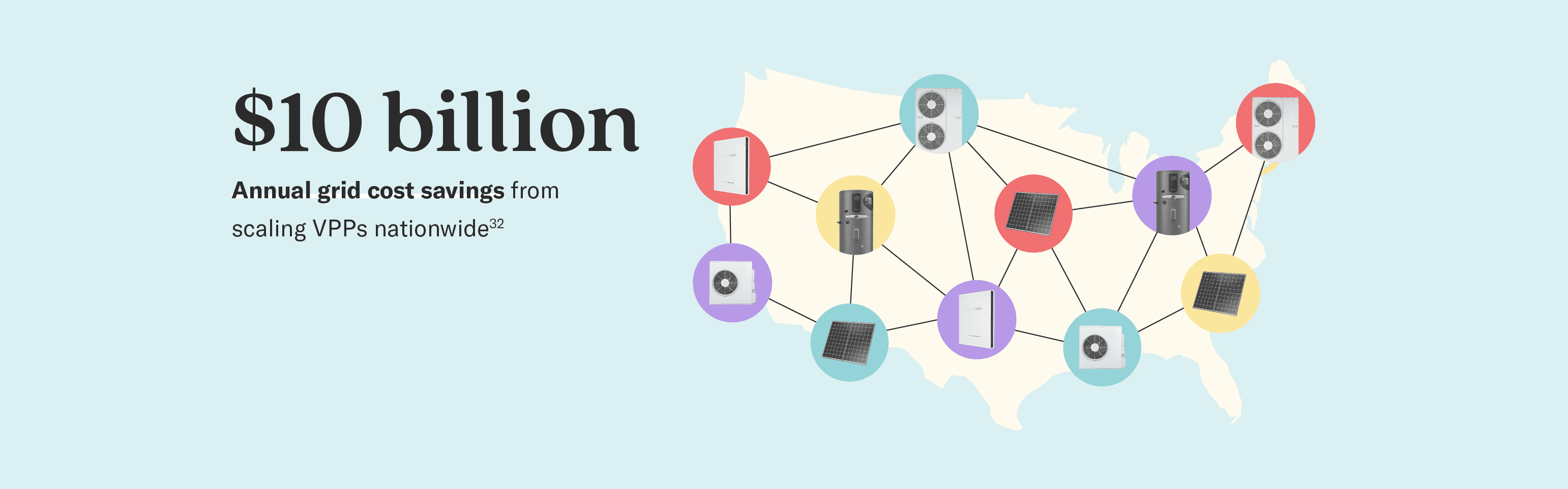
The benefits of VPPs are already visible at scale. The United States has roughly 37.5 GW of flexible distributed capacity enrolled in VPP-style programs, and DOE analysis estimates that expanding this to 80–160 GW by 2030 could save about $10 billion per year in grid costs by avoiding new infrastructure and peak generation.28 In an era of rapid load growth, VPPs represent one of the fastest ways to add effective capacity without waiting years for new generation or transmission.
The core policy challenge is not technology readiness. It is establishing retail programs that compensate distributed resources for the grid services they provide, so utilities can rely on those resources in formal planning processes and allow them to fully participate in energy and capacity markets.
Potential impact
VPP programs can expand within 6–24 months through regulatory proceedings, utility filings, or legislative direction29 — far faster than building new power plants or major grid upgrades. The primary system value is cost containment: by reducing peak demand and providing dispatchable flexibility, VPPs defer the need for new peaker plants and transmission infrastructure, creating savings for all ratepayers.
VPP participants also benefit directly. In California, households earn roughly $500–$1,000 per year;30 In Massachusetts, battery owners can receive up to ~$275 per kW per season, meaning a typical 10 kW battery could earn several thousand dollars annually.31 Stable VPP compensation also unlocks new financing models — enabling utilities to offer free or low-cost devices to households based on future income streams.
Because VPP program design varies significantly, we do not model VPP impacts on household affordability directly. However, VPPs are a critical enabler of hyperscaler investment: they provide a credible pathway for aggregating, measuring, and relying on the grid benefits of electrified households.
Policy design
The highest-leverage VPP policy interventions ensure distributed flexibility can be reliably accredited, fairly compensated, and easily scaled.
They include:
Statewide flexibility targets: Set clear targets for flexible capacity (e.g., MW or percent of peak demand) with ramp-up milestones and performance reporting to move VPPs from pilots to core resources.
Utility program requirements: Direct utilities to develop and scale VPP programs where they are absent or insufficient.
Capacity accreditation and valuation reform: Establish clear, standardized rules for measuring and accrediting aggregated distributed energy resources so utilities can rely on them for resource adequacy and planning. Ensure these aggregations can participate in wholesale markets by addressing retail tariff conflicts and advancing implementation of FERC Order 2222.
Multi-service compensation: Compensate VPPs for the full range of services they provide — including peak capacity, reliability, and distribution-level benefits — across both energy exports and load reductions.
Integration into utility planning and procurement: Require utilities to evaluate distributed flexibility alongside traditional infrastructure and treat it as a preferred option when cost-effective. This requirement does not prohibit new infrastructure but ensures utilities transparently compare traditional investments with distributed flexibility solutions before committing ratepayers to long-term capital spending.
Standardized enrollment, data access, and interoperability: Streamline enrollment pathways and establish clear standards for device interoperability and customer data access. States can accelerate VPP growth by requiring standardized enrollment frameworks, defining minimum performance data for verification, adopting privacy-safe data access standards (e.g., Green Button Connect My Data), and supporting open communication protocols to reduce vendor lock-in and enable scaling.
Equitable access: Ensure low-income households and renters can participate through targeted programs, outreach, and financing.
Examples
California established a statewide goal of achieving 7 GW of load-shifting capacity by 2030. Proposed legislation would have required the California Energy Commission to track and accelerate progress toward this target, illustrating how states can set clear, system-wide goals for distributed flexibility.

Washington: HB 1589/SB 5562 (2023, enacted)
Virginia: HB 2346/SB 1100 (2025, enacted)
New Mexico: HB 311 (2025, proposed)
Illinois: SB 25 (2026, enacted)
Several states are requiring utilities to develop and scale VPP programs or meet defined flexibility targets. Washington required Puget Sound Energy to meet 10 percent of peak demand with demand flexibility by 2027. Virginia required Dominion Energy to propose a VPP pilot program of up to 450 MW and integrate distributed resources into reliability planning. New Mexico proposed requiring investor-owned utilities to offset at least 15 percent of peak demand with VPPs. Illinois’ Clean and Reliable Grid Affordability Act sets a 3 GW energy storage target by 2030 and directs utilities to develop VPP programs.

Maryland’s DRIVE Act enables the Public Service Commission to require utilities to offer upfront incentives for customer-sited energy systems, but only if customers commit to provide grid support for at least five years, aligning household benefits with system value.33 In implementation, regulators have directed utilities to expand pilot proposals to reach broader customer participation.

Louisiana: Entergy demand response and battery programs (2025, active)
Entergy Louisiana and Entergy New Orleans have proposed and begun implementing a suite of demand response and battery storage programs, including smart thermostat and residential battery aggregation initiatives. In December 2025, the New Orleans City Council approved these programs and directed the utility to expand its battery pilot into a larger-scale offering, signaling a pathway from pilot projects to full VPP deployment.
Best when...
VPPs deliver the greatest value in system conditions where flexible demand and distributed resources can replace or defer expensive, slow-to-build infrastructure. This is especially true when:
Load growth is rapid (e.g., data centers, EV adoption, electrification), creating near-term capacity needs that cannot be met quickly with traditional infrastructure
Capacity constraints are binding, driving new peaker plant proposals or delaying the retirement of aging, high-cost generators
Transmission and distribution costs are rising, putting upward pressure on utility bills and increasing the value of deferring or avoiding infrastructure upgrades
Existing distributed energy resources adoption is growing, providing a foundation of assets that can be aggregated into VPPs
Political prospects
VPPs have growing bipartisan momentum because they offer a way to add capacity quickly, contain rate increases, and meet near-term load growth without committing ratepayers to decades of new infrastructure spending. To scale effectively, programs must build confidence across stakeholders — giving utilities and regulators certainty that VPPs will deliver when needed, ensuring customers retain control over their devices and data, and expanding access for low- and moderate-income households to participate.
Conclusion
The next decade will bring a wave of energy investment — and with it, a generational choice. We can continue down a path where that spending reinforces a system that extracts wealth from households and communities, or we can seize this moment to build community power.
Affordability is a policy design choice. Together, the six policies we have laid out here treat households as energy infrastructure, increasing savings and amplifying system value. When deployed at scale, they make modern energy upgrades affordable for the vast majority of households — unlocking tens of thousands of dollars in savings per family and over a trillion dollars nationwide.
States that act now can turn this moment of disruption into an opportunity to lower costs, strengthen the grid, and deliver immediate, visible benefits to millions of American families.
Endnotes
PowerLines, Utility Spending is Rising: A Review of Utility Capital Expenditure Plans, 2026.
Rewiring America, Electrification that works, 2024.
SEIA/Wood Mackenzie, Power & Renewables U.S. Solar Market Insights, 2024.
Aterio, U.S. data centers and power demand, 2026.
RMI, It’s Time to Stop Overcharging Heat Pump Customers. Electrified Heating Rates Can Help, 2025.
Aterio, U.S. data centers and power demand, 2026.
Rewiring America, Homegrown Energy: How household upgrades can meet 100 percent of data center demand growth, 2025.
SPUR, Greenlighting Clean Heat: Modernizing Permits for Heat Pumps, 2025.
Permit Power, As Cheap As Our Peers, 2025.
Tesla, Tesla Energy: Breaking the Cost Barrier in Residential Energy, 2025. PV Magazine, How to cut U.S. residential solar costs in half, 2025.
Grid Strategies, Strategic Industries Surging: Driving US Power Demand, 2024.
McKinsey & Company, The cost of compute: A $7 trillion race to scale data centers, 2025.
Advanced Energy United, The Next Decade in PJM: A Path to Reliability and Affordability, 2026; Camus, Flexible Data Centers: A Faster, More Affordable Path to Power, 2025.
For example, large load tariffs can include minimum contract lengths, demand guarantees, or exit fees to prevent stranded infrastructure costs from falling to households. Sierra Club, Data Center State Policies 2026, 2026.
Alliance to Save Energy and the Ad Hoc Group, Bridging the Load Gap: A Collaborative Path for Utilities, Hyperscalers and Customers, 2026.
Clean Energy Works, Introduction to Inclusive Utility Investments, 2023.
For a comprehensive list of consumer protections see EPA, Inclusive Utility Investment.
Modeling that meets the BPI-2400 standard.
In the Pay As You Save® model of IUI, no more than 80 percent of the estimated savings can be used for cost recovery, ensuring at least 20 percent flows directly to the customer. Pay As You Save® is a specific branded subset of IUI with strict parameters to standardize best practices, especially consumer protections. It was first developed by the Energy Efficiency Institute in 1999. Energy Efficiency Institute (EEI), PAYS Essential Elements, Last updated 2021.
CET, Unlocking Residential Electrification with Inclusive Utility Investments in Ipswich, 2024.
Berkeley Lab, ACEEE Summer Study on Energy Efficiency in Building: Customer Outcomes in Pay-As-You-Save Programs, 2022.
Massachusetts Office of the State Auditor, New Report by State Auditor’s Office Identifies Significant Inequities in Mass Save Program, 2025.
Spare grid capacity also exists in the spring and fall “shoulder” seasons.
NYSERDA, New Efficiency: New York Analysis of Residential Heat Pump Potential and Economics Final Report | Report Number 18-44, 2019.
Under prior default rates, only about 45 percent of households switching to heat pumps would have seen savings. The approved rates raise that share to ~64 percent. DPU is evaluating a proposal to implement greater discounts proposed by state agencies that could broaden the share of savings to ~82 percent of households, with median savings of about $687 per household. Canary Media, New winter rates saved at least $37M for Massachusetts heat-pump owners, 2026.
Brattle Group, PC44 Time of Use Pilots: End of Pilot Evaluation, 2021.
Strategen for the Lawrence Berkeley National Laboratory, Non-Pipeline Alternatives to Natural Gas Utility Infrastructure: An Examination of Existing Regulatory Approaches, 2023.
U.S. Department of Energy, Virtual Power Plant Projects, 2025.
Virtual Power Plant Partnership (VP3), Meeting Summer Peaks: The Need for Virtual Power Plants, 2024.
The Brattle Group, California’s Virtual Power Potential: How Five Consumer Technologies Could Improve the State’s Energy Affordability, 2024.
Mass Save, Battery Storage, 2026.
U.S. Department of Energy, Virtual Power Plant Projects, 2025.
This provision specifically is located in Section 7-1006 of the DRIVE Act. In practice, it uses financial incentives to drive adoption of distributed energy resources while ensuring those systems can be aggregated to deliver distribution system benefits. The Maryland PSC is facilitating all DRIVE Act filings through Docket No. 9761.
Appendix
Read more about the methodology and sources we used in this report:
Acknowledgments
Report authors
Kristin Eberhard, Miki Verma, Alex Amend, Becca Curry, Noah Goldmann, Isa Peterson, Amanda Sachs
Staff contributors
This report was a true team effort, and would not have been possible without the talents of: Nicole Bode, Jessica Dulaney, Gaby Hills, Amy LaThanh, Alex Lopez, Ari Matusiak, Erin Mettler, Yazmyn Pelaez, Courtney St. John, Maddie Tamagni, Roxy Torres, Chloe Yeo
Acknowledgments
The authors would like to thank the following external reviewers for providing their expertise to the report: Hannah Birnbaum and Nick Josefowitz, Permit Power; Thadeus Culley, Sunrun; Chloe Holden and Sarah Steinberg, Advanced Energy United; Mary Rafferty, Common Charge; Michael Reiner and Matt Flaherty, Clean Energy Works; Tony Sirna, Evergreen Action