Rewiring America releases “Homegrown Energy” blueprint to lower costs for 96 percent of eligible US households
New analysis shows treating households as energy infrastructure can deliver $1.5 trillion in savings while meeting rising demand.
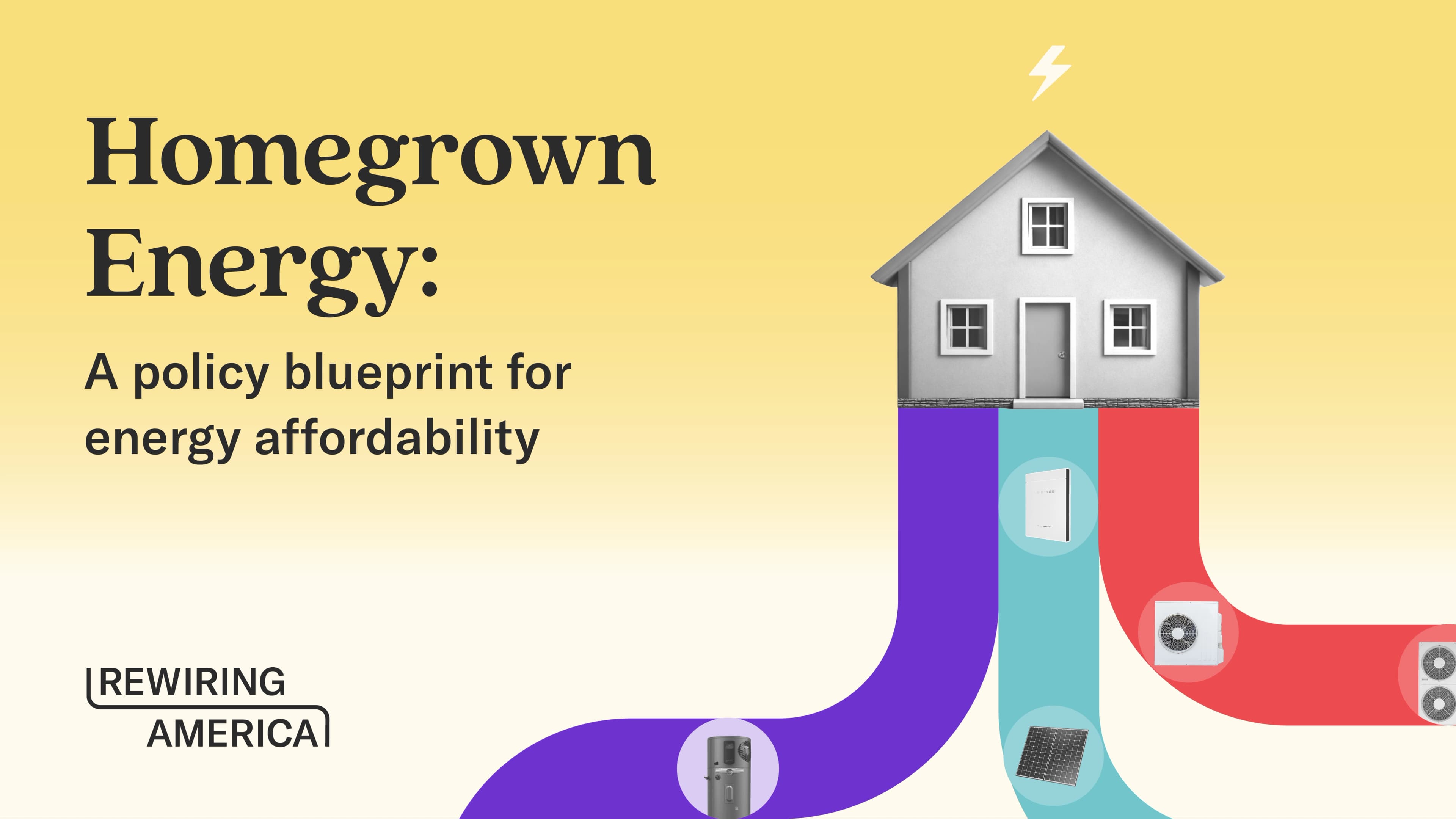
WASHINGTON, D.C. — Today, Rewiring America released a new national policy report, Homegrown Energy: A policy blueprint for energy affordability, outlining how states can lower energy costs, meet rising electricity demand, and deliver direct benefits to households by investing in American homes.
The report comes at a moment of rising energy costs and growing public skepticism about how the energy system is being built and who it is designed to serve. The US is entering one of the largest energy investment cycles in generations, driven by data center growth, aging infrastructure, and utility spending, even as households struggle to keep up with rising bills.
The report lays out a different path forward, a win-win approach that lowers costs for households while meeting growing energy demand. With the right policies, whole-home electrification, rooftop solar, and battery storage could become affordable for 96 percent of eligible US households, up from roughly 9 percent today, delivering about $26,000 in lifetime savings per home and $1.5 trillion in total savings nationwide. These policies would also create up to 1.1 million durable, local jobs in installation and maintenance.
“Right now, 9 out of 10 households are blocked by current policy choices from accessing upgrades that would lower their bills and improve comfort, safety, and reliability,” said Ari Matusiak, Founder and CEO of Rewiring America. “That’s a failure of priorities. We can harness this wave of investment to lower costs for households while strengthening the system. That’s the foundation of a new social compact, and it starts by treating homes as energy infrastructure.”
The report argues the US faces a generational choice in how it meets soaring energy demand. The current approach, centered on expanding centralized infrastructure, is increasingly being challenged by communities concerned about costs, environmental impacts, and limited local return.
Even when the current approach delivers system-wide savings, it can take years for the benefits to reach households. By contrast, direct investment in homes delivers faster, visible results. As utilities and large energy users, including AI companies, face growing pressure to demonstrate public value, communities are demanding a clearer stake and more immediate benefits.
The policy blueprint identifies six interlocking policies that align energy system investment with household savings:
Reducing permitting and soft costs
Requiring large new energy users to invest in distributed resources
Scaling virtual power plants
Enabling inclusive utility investment
Modernizing electric rate design
Redirecting gas infrastructure investment
Together, these policies create a self-reinforcing cycle: lowering costs drives adoption of better bill-saving technology, greater adoption unlocks grid value, and that value attracts new investment. As more capital flows into households, affordability expands further — driving down costs over time and reducing the need for ongoing subsidies.
“People don’t support infrastructure when they’re asked to carry the costs without sharing in the benefits,” Matusiak added. “They support investments they understand and benefit from. This is how we build an energy system that delivers for households, communities, and the economy at the same time.”
"For decades, we treated homes as passive consumers of energy,” said former Washington Governor Jay Inslee. “This report shows us how to flip that equation—turning every rooftop, heat pump, and electric vehicle into power plants for the 21st century. Every governor should read it."
“States and utilities cannot afford to rely exclusively on expensive, long-lead infrastructure investments to meet rising demand,” said Allison Clements, principal at 804 Advisory and former member of the Federal Energy Regulatory Commission. “This report shows how states can reduce costs more quickly by incorporating flexible household resources into planning, affordability, and reliability strategies.”
“America’s economic success increasingly hinges on our ability to break new ground in making our energy system more efficient and affordable,” said Brian Deese, Co-Founder and Chief Executive Officer of Foundry-Logic and former Director, National Economic Council, White House. “This blueprint makes an important contribution to that mission by showing how we can empower American families to lead in that effort.”
"Data center companies are facing real community pushback — and they've earned it,” said Jigar Shah, Host of the Energy Empire and Open Circuit podcasts and former Director, DOE Loan Programs Office. “They're adding massive load to the grid, driving up everyone's bills, and delivering little back to the neighborhoods they're moving into. This report gives them a playbook to change that story. Invest in the homes around you. Fund the heat pumps, the solar, the storage. Turn your energy burden into a community asset. That's not just good politics — it's the fastest path to getting the power you need."
“This clear and compelling blueprint raises a simple question: what are we waiting for?," said Abigail Dillen, President of Earthjustice. "Decision-makers across the country are grappling with rising demand and higher energy costs. This report lays out a common-sense set of solutions to make energy more affordable, healthier, and more reliable for American households.”
"This is both brilliant and important,” said Bill McKibben, Co-Founder of 350.org and Third Act. “If you're feeling overwhelmed by the ever-rising cost of electricity, here's an understandable set of prescriptions that will take us a long way towards a more affordable future—and might even help bail out the planet along the way!"
“This report highlights the power of putting households at the center of the energy system,” said Lynn Jurich, Co-Founder and Co-Executive Chair of Sunrun. “Rooftop solar and home batteries are already helping families lower their energy bills and gain more control over the power they need. With the right policies, we can scale these solutions to deliver affordable, reliable energy to millions more households.”
“Homes account for nearly 40% of electricity demand, making them one of the fastest, most scalable ways to strengthen the grid,” said Hakan Yilmaz, President, Carrier Energy & Chief Sustainability Officer. “By pairing intelligent HVAC with behind-the-meter storage, we can turn everyday homes into flexible energy assets — improving affordability, resilience, and system reliability at scale.”
“Rewiring America’s policy blueprint comes at a time when energy security and affordability are top of mind,” said Jon Creyts, Chief Executive Officer of RMI. “Their recommendations show how a handful of market-based policies can bridge and solve for both of those concerns. By treating households as energy infrastructure and fixing the rules that drive costs up, states can make clean energy upgrades affordable for nearly every American family. The payoff is enormous—lower bills, a stronger and more resilient grid, and over a trillion dollars in lifetime savings nationwide.”
“The report gets it right,” said Joshua Greene, Vice President of Government, Regulatory and Industry Affairs at AO Smith. “Efficient, grid-interactive appliances like heat pump water heaters are critical to lowering bills and managing new demand. Scaling these solutions is one of the most practical ways to integrate data centers and other large loads without raising costs for consumers.”
“We are experiencing a once in a generation opportunity to reshape our electric grid,” said Dana Guernsey, Chief Executive Officer of Voltus. “At Voltus, we see every day that deploying distributed capacity is the fastest, cleanest, and most affordable solution to the growing capacity crunch. The good news is that this capacity is already available in homes and communities across the country. The bad news is that residential consumers are too often being left behind due to policy barriers. Rewiring America’s blueprint gives states a practical path to meet this moment. By recognizing households as grid assets, we can lower bills, support reliability, and turn load growth into a catalyzing opportunity for investment in American households."
“This blueprint recognizes a reality the energy system is only beginning to fully account for: homes can help the grid,” said Sam Calisch, Founder and CEO of Copper. “Families want cleaner, lower-cost energy solutions, but too often the process is still out of reach financially. Pairing batteries with the high-efficiency electric appliances families already rely on, from heat pumps to induction stoves, opens up enormous possibilities. These technologies can improve comfort, resilience, and control for households while helping the grid operate more efficiently. The opportunity now is to make these solutions easy and affordable to deploy at scale. This blueprint arrives at a crucial time to help make that vision a reality.”
"Rooftop solar energy can be a solution to the energy affordability crisis," said Anya Schoolman, Executive Director of Solar United Neighbors. "This thorough new report from Rewiring America shows how. It is a valuable resource for solar supporters as we continue our fight for an electric system that benefits everyone."
"Complicated, slow and expensive permitting, interconnection and financing puts these utility-bill savings investments out of reach for too many American families," said Nick Josefowitz, Founder and Chief Executive Officer of Permit Power, an energy affordability non-profit. "This report lays out a compelling vision for how to cut the red tape to make utility-bill saving investments like home solar, batteries and home electrification affordable for tens of millions more American families."
“We keep pouring money into an energy system built around corporate profits when we should be investing in one that works for American households,” said Tony Sirna, Evergreen Action Deputy Policy Director for Buildings. “This report is a blueprint for changing that: scaling efficient, all-electric upgrades is the fastest way to lower bills and build a cheaper, more resilient energy system that actually serves the people paying for it.”
"Solutions to our energy needs don't have to be built from scratch — the fastest and cheapest path to meet new demand is on rooftops and in garages across America, ready to be put to work,” said Mary Rafferty, Executive Director of Common Charge. “The question is whether we have the policy imagination to use it. At a time when policymakers are under real pressure to lower energy bills, this report makes clear that distributed assets aren't just a clean energy story, they're an affordability answer."
Rewiring America puts American households at the center of an affordable, resilient, all-electric future. We partner with policymakers, industry leaders, manufacturers, workers, and communities to strengthen the electric grid, lower energy prices, and build homegrown energy solutions for all.