Governors can unlock faster, lower-cost electricity through “Homegrown Energy”
Investment in heat pumps, solar, and batteries can meet rising AI-driven demand, lower prices, and deliver direct benefits across the PJM region.
WASHINGTON — As electricity demand surges from AI and data center growth, communities across the Midwest and East Coast are growing increasingly skeptical of rising costs and unclear local benefits. A new policy memo from Rewiring America outlines how states, tech companies, and PJM Interconnection — the regional grid operator responsible for coordinating electricity markets across 13 states and Washington, D.C. — can meet this moment by addressing skyrocketing demand with visible, household-level benefits.
Released today, “Homegrown Energy: Making the AI boom work for everyone,” presents a bipartisan framework that goes beyond making data centers “bring their own energy.” Instead, this framework ensures data centers pay their fair share by investing in customer-owned resources and treats them as real energy infrastructure.
Rather than relying solely on large-scale infrastructure that takes years to build and costs billions, the memo outlines how scaling distributed energy resources — including weatherization, energy-efficient heat pumps, rooftop solar, battery storage, and virtual power plants — can harness lower-cost, more efficient solutions that cut bills and expand grid capacity. These community power solutions provide a framework that state leaders, data center developers, and PJM could adopt to address both energy bottlenecks and growing public concern about affordability and fairness.
“Stopping bills from skyrocketing is a start, but it’s not enough. We have a chance to do more — to make sure AI energy demand actually helps regular families,” said Rewiring America CEO Ari Matusiak. “If we’re going to spend big on energy infrastructure, we should spend it on our own homes and neighborhoods first. These are the kinds of investments that lower monthly bills, make the grid stronger, and leave families in a better spot.”
The brief warns that traditional grid upgrades to meet the projected 30-gigawatt surge in AI demand could cost hundreds of billions of dollars, potentially hiking the average household energy bill by $840 per year. Meanwhile, data center developers face "speed to power" delays of up to seven years due to a backlogged grid.
A faster path to power
The memo highlights a key challenge facing PJM: interconnection timelines for large new loads now stretch three to seven years, delaying projects and economic development.
By contrast, home and community-based upgrades can be deployed in as little as six to 24 months, creating immediate capacity on constrained parts of the grid and accelerating “speed to power” for new data center projects.
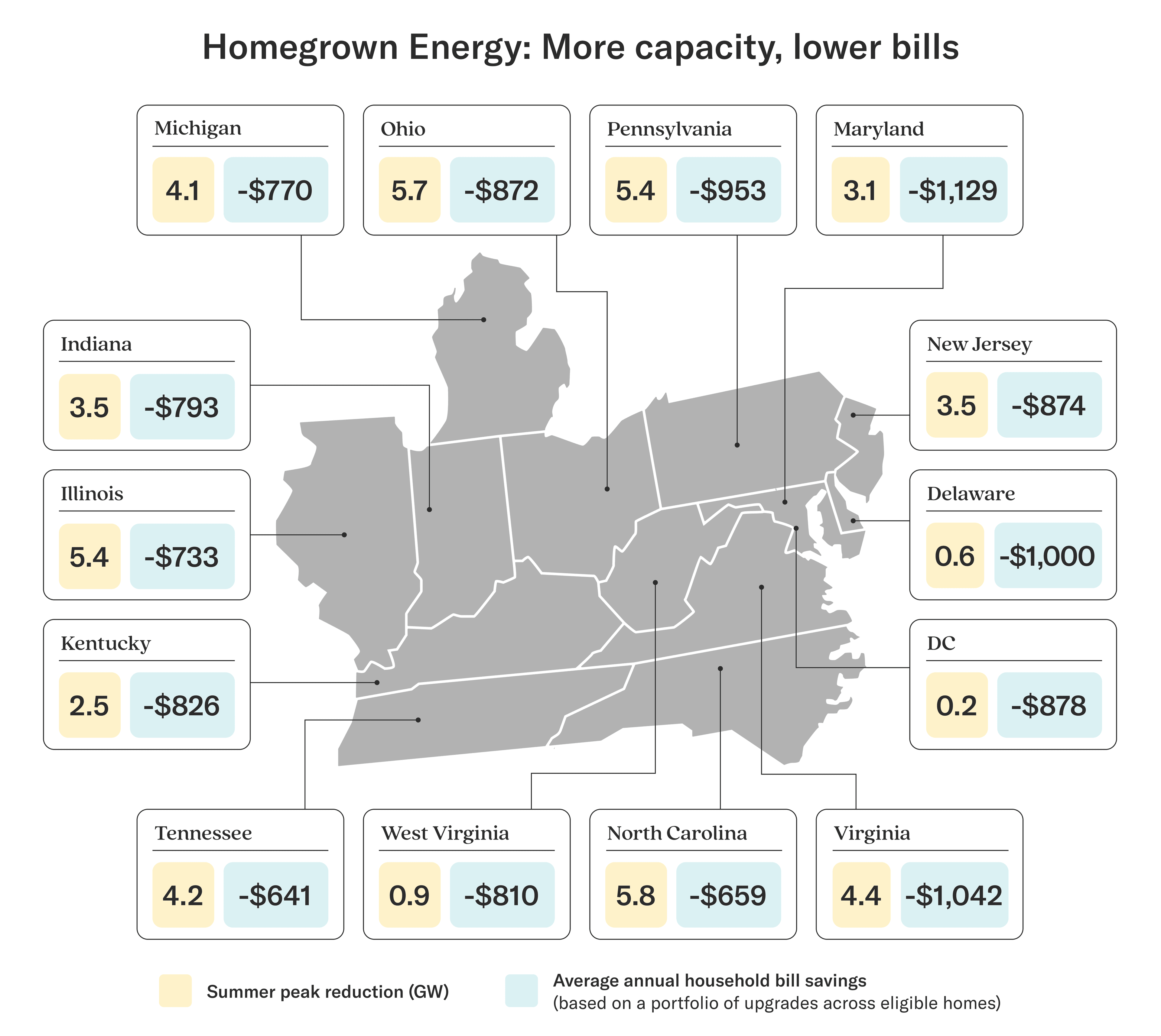
Across the PJM region, household upgrades alone could provide at least 49 gigawatts of capacity — 1.6 times projected data center demand growth.
“Governors can set ambitious targets here and unlock a faster, lower-cost path to meeting demand,” added Matusiak. “The data shows that household and community-based upgrades could deliver more than enough capacity to meet projected demand in PJM, and do it in a fraction of the time.”
Turning growth into lower bills
The Homegrown Energy framework pairs data center growth with targeted investments in communities and treats those investments as energy infrastructure:
Lower energy bills: Home upgrades can save households more than $850 per year on average, with savings reaching $2,900 annually for homes replacing electric resistance heating
Reduced system costs: Distributed resources can defer expensive infrastructure, lowering total electricity system costs by 20 to 40 percent and putting downward pressure on capacity prices across PJM
Job creation: Up to 375,000 skilled-trades jobs across the PJM region
Grid reliability: Flexible, distributed capacity reduces peak demand and strengthens resilience
“When home upgrades are recognized for the capacity they provide, they become a fast, reliable, speed-to-power, and community-affirming resource that is built into how the system plans and pays for energy,” said Matusiak. “This takes households from the back of the line to the front, and turns them into a core part of how we meet demand, lower costs, and build a grid that works for everyone.”
Modernize the grid
The brief outlines three specific steps state leaders can take to modernize their grids and protect ratepayers:
Set Homegrown Energy targets: Establish goals within and across PJM states to link data center growth with the deployment of distributed energy resources.
Create clear investment pathways: Work with state legislators and public utility commissions to establish mechanisms that allow, enable, and incentivize hyperscalers to invest in distributed resources.
Value distributed capacity: Encourage PJM to ensure home energy upgrades are counted as reliable "capacity" in grid planning.
A regional opportunity
Because PJM operates a shared regional grid, the benefits of Homegrown Energy extend beyond any single state. Reducing peak demand in one part of the PJM footprint can lower capacity procurement obligations, putting downward pressure on clearing prices across the region.
The memo emphasizes that coordinated action across PJM states is essential to turning isolated programs into a durable, scalable strategy that meets demand, lowers costs, and accelerates economic growth.
“The AI boom is already reshaping the region,” said Matusiak. “With the right framework, it can also lower energy bills, create jobs, and build a stronger grid.”
Rewiring America puts American households at the center of an affordable, resilient, all-electric future. We partner with policymakers, industry leaders, manufacturers, workers, and communities to strengthen the electric grid, lower energy prices, and build homegrown energy solutions for all.