Voters are skeptical of data centers, but they support Homegrown Energy
New polling shows broad, bipartisan support for requiring data centers to invest in household energy upgrades that lower bills, reduce demand, and deliver direct community benefits.
The Yale Program on Climate Change Communication's latest Climate Change in the American Mind poll, released June 9, confirms a political reality across the country: the public is deeply skeptical of hyperscale data center growth. Fifty-eight percent of registered voters oppose building data centers in their area, and 60 percent believe a nearby data center would raise their electricity bills.
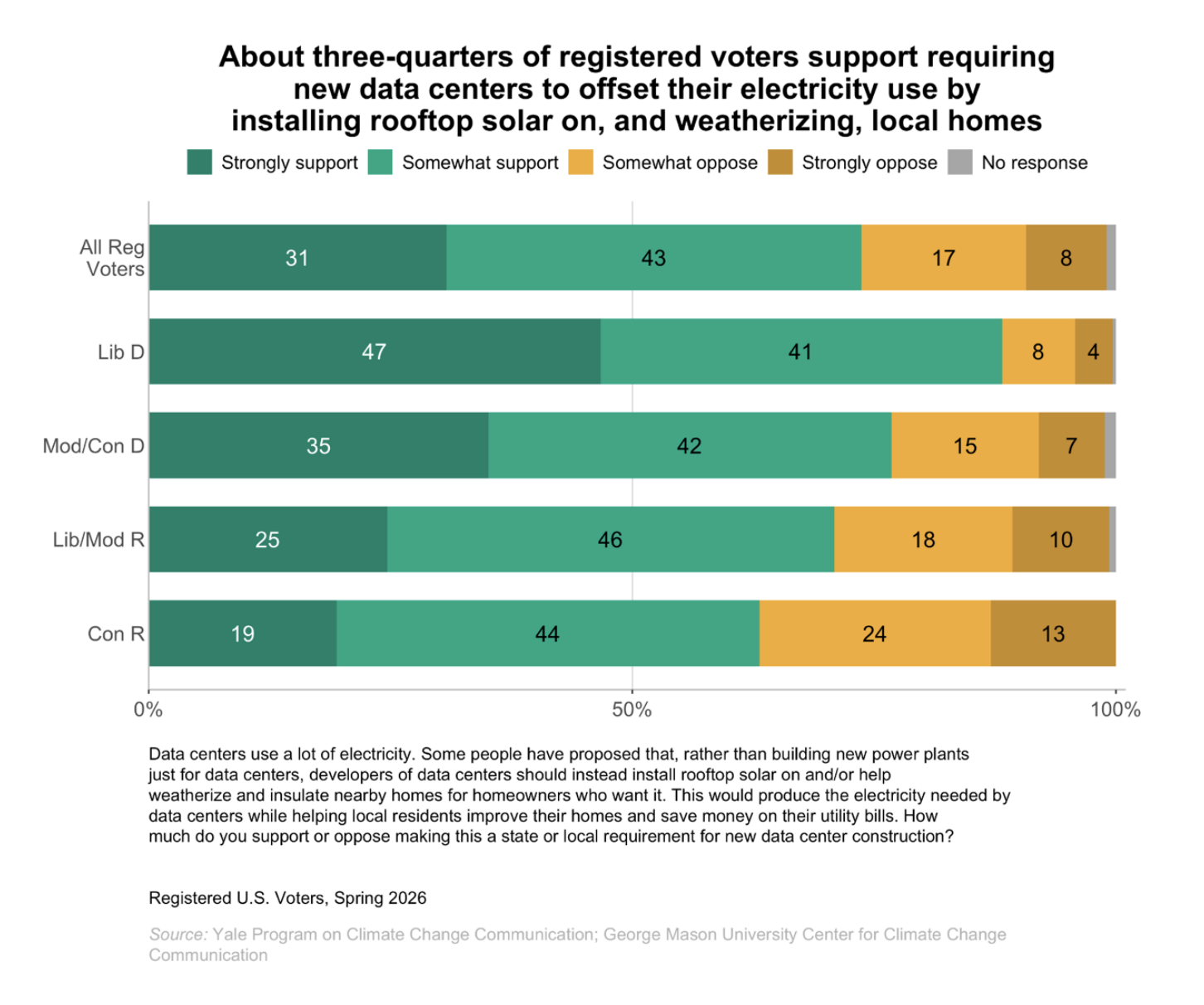
But the poll also points to a way forward. Nearly three-quarters of registered voters, 74 percent, support requiring new data centers to offset their electricity use by installing rooftop solar on, and weatherizing, local homes. That support crosses party lines, including 88 percent of liberal Democrats, 77 percent of moderate and conservative Democrats, 71 percent of liberal and moderate Republicans, and 63 percent of conservative Republicans.
So why isn’t this approach talked about more?
For too long, the data center energy debate has been framed as a choice between building massive new centralized energy infrastructure or risking grid reliability. At a minimum, data centers should pay the full cost of the infrastructure needed to serve them. But preventing cost-shifting is only the floor. That frame leaves out one of the fastest, most practical, and most popular solutions available: investing in homes, businesses, and communities as part of core grid infrastructure.
Rewiring America’s Homegrown Energy research shows that large new energy users, including data centers, can help pay for distributed energy resources that lower bills, reduce peak demand, and strengthen the grid. Requiring or incentivizing hyperscalers to fund household and community energy upgrades creates measurable grid capacity and delivers direct public benefit.
That can include investments in rooftop solar, batteries, heat pumps, weatherization, smart controls, and upgrades to homes, schools, businesses, and community buildings.
The benefits are shared. Households get lower bills, healthier homes, more resilience, and more control. Communities get local jobs across HVAC, electrical work, solar, storage, weatherization, construction, and maintenance, plus domestic manufacturing opportunities. Utilities get faster, lower-cost capacity that can reduce peak stress and defer expensive infrastructure. Hyperscalers get a more credible pathway to power.
Policymakers are beginning to move in this direction. Illinois’ proposed POWER Act would establish large-load tariffs, require data centers to bring new clean capacity or reduce load during peak periods, and explicitly allow distributed resources to count toward compliance. Minnesota has enacted annual data center fees to support low-income efficiency upgrades and grid modernization programs, while similar fee-based approaches are being explored in other states.
These are important steps, but they are not yet ambitious enough. Fees and compliance options can establish a baseline, but the scale of data center-driven demand requires a larger, market-based pathway for directing private capital into distributed capacity. States should move beyond narrow cost allocation and modest fees toward policies that make household and community energy upgrades a central part of how large new loads meet their capacity needs.
The June 2 agreement between Voltus and Google shows the potential and momentum. While not directly tied to a new large load user, Voltus will aggregate up to 100 megawatts of distributed energy resources each year from local homes and businesses into a Google-funded virtual power plant in PJM. Participating customers are paid for helping meet grid needs, while the grid gains local capacity without relying only on slow, expensive centralized infrastructure.
While the concept of virtual power plants focuses on the ongoing coordination of distributed resources, our core “data centers pay” concept focuses on how those resources get built in the first place. Specifically, how large new energy users help cover the upfront cost of upgrades that create capacity for the grid.
The Yale polling points to serious potential for this approach. The Voltus/Google agreement demonstrates technical feasibility, as well as validation of the approach from one of the world’s biggest tech companies.
The public is looking for a better deal. State legislators are beginning to write that deal into policy. And early market activity is showing that large-load growth can be linked to direct benefits for households and communities.
The next step is to make this approach bigger, more durable, and more enforceable. That's how we make Homegrown Energy a reality.
Rewiring America puts American households at the center of an affordable, resilient, all-electric future. We partner with policymakers, industry leaders, manufacturers, workers, and communities to strengthen the electric grid, lower energy prices, and build homegrown energy solutions for all.