The household battery boom points to a Homegrown Energy future
More and more families are installing home batteries for resilience, bill control, and energy security; a trend that shows why households should be treated as energy infrastructure.
A new Bloomberg Green story highlights a striking trend: even as residential solar installations have slowed, home battery installations are surging.
Citing data from the U.S. Energy Information Administration, Bloomberg reports that homeowners installed a record 673 megawatts of battery storage in the first quarter of 2026, driven largely by state incentives in California, Hawaii, Texas, and Arizona. As Rewiring America founder and CEO Ari Matusiak told Bloomberg: “You’re seeing state policy demonstrate its importance.”
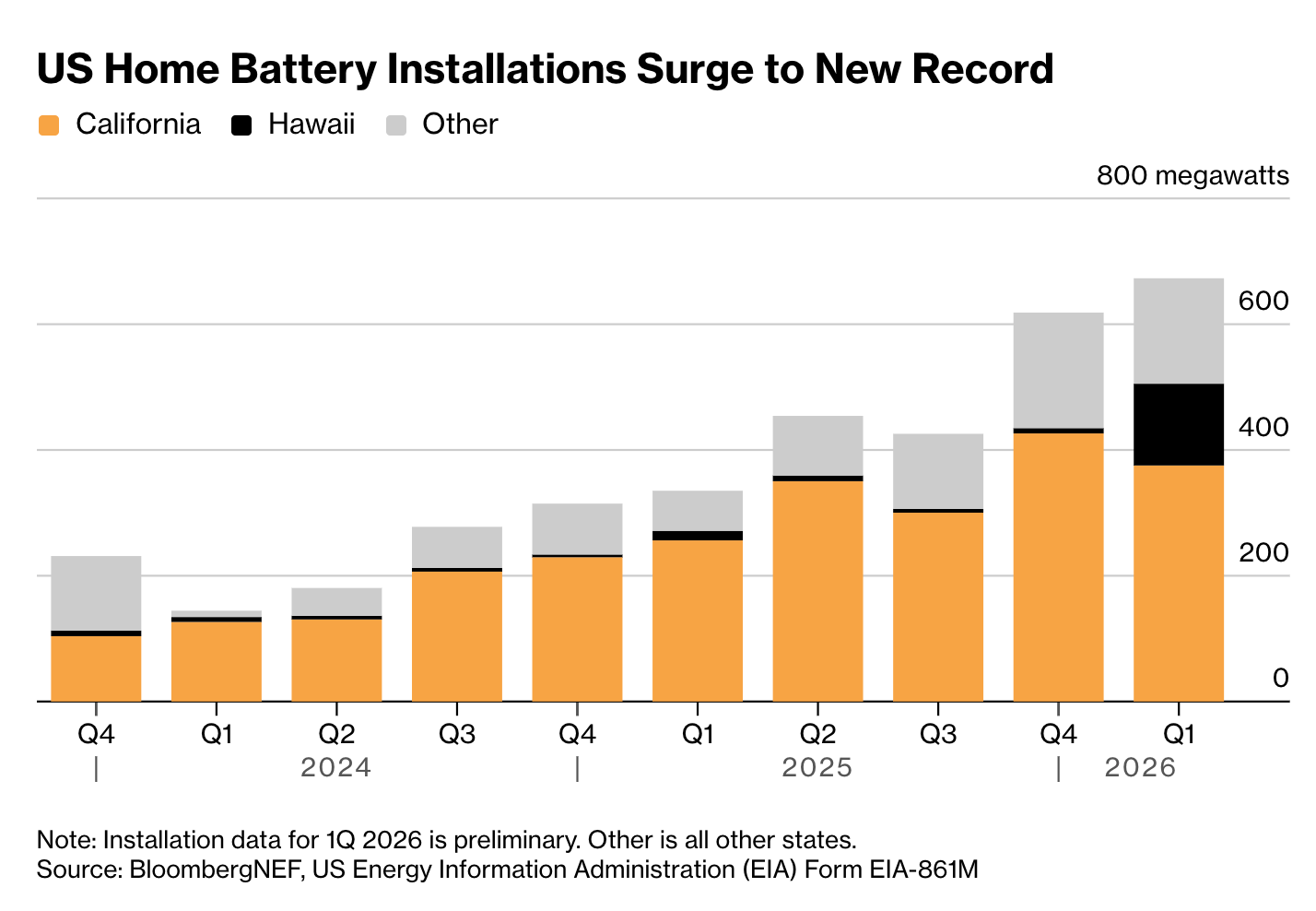
Other market data point in the same direction. The latest U.S. Energy Storage Monitor from Wood Mackenzie and the American Clean Power Association found that residential storage hit a record 1.3 gigawatt-hours in Q1 2026, up 86 percent year over year. The national residential solar-plus-storage attachment rate (where solar installations are paired with storage) also reached 45 percent, up from 38 percent a year earlier.
That matters because the battery story shows that the household energy value proposition is changing. Solar-only installations may be facing federal policy-driven headwinds, but homeowners who do go solar are increasingly pairing it with storage, which is a sign that consumers want more than clean power. They want backup power, protection from peak prices, and more control as bills rise, outages increase, and the grid faces new pressure.
Recent EnergySage data reinforces the point. After demand cooled earlier in the year following the expiration of federal tax credits, quote requests for solar-plus-storage jumped 21 percent in just 23 days in March. EnergySage tied that renewed interest to rising utility bills, outage risk, extreme weather, geopolitical volatility, aging grid infrastructure, and new demand from AI and data centers.
Rewiring America’s Homegrown Energy research shows the bigger opportunity: households can be grid assets. Battery storage, rooftop solar, heat pumps with smart controls, and other flexible technologies can deliver power or reduce demand when the grid is stressed. In our first Homegrown Energy report, we found that if every single-family household installed a battery, and homes with suitable roofs added a 5 kW solar system, they could collectively provide 109 GW of increased capacity to the grid — about 24 times the capacity of Plant Vogtle, the largest and most modern nuclear power plant in the U.S.
That matters as electricity demand rises, especially from AI and data centers. Communities should not be asked to absorb those costs through higher bills. Large new loads should pay their full way and fund local household upgrades that lower bills, improve resilience, and strengthen the grid.
Public opinion research bears this out. Households are more willing to accept incoming large-load demand when it comes with clear guardrails, and tangible improvements for them and their families. Polling from Yale University and George Mason University found that while voters are skeptical of nearby data centers, 74 percent support requiring new data centers to offset their electricity use by installing rooftop solar and weatherizing local homes.
And now the Bloomberg report shows the market is already moving. The policy opportunity is right in front of us.
Rewiring America puts American households at the center of an affordable, resilient, all-electric future. We partner with policymakers, industry leaders, manufacturers, workers, and communities to strengthen the electric grid, lower energy prices, and build homegrown energy solutions for all.