Recently, the Breakthrough Institute published an article taking issue with two flagship reports Rewiring America has released under the banner of Homegrown Energy. Its central premise, that we advocate for home upgrades instead of grid investment and new electricity generation, is wrong.
Smart, flexible, and battery-integrated energy technologies can help modernize the grid while lowering household costs. We do not present them as a silver bullet. We are explicit that they should complement new clean generation, transmission, and grid modernization while delivering direct benefits to households and communities.
As Rewiring America CEO Ari Matusiak wrote in Governing in May:
Alongside necessary investments in new clean generation and grid expansion, states can choose to treat households as core energy infrastructure by adopting policies that make heat pumps, rooftop solar, home batteries and smart electric appliances vastly more affordable.
Rewiring America has always focused on helping households lower bills, improve comfort and resilience, and gain more control over their energy use. The Homegrown Energy framework applies that focus to the electricity load growth era.
Investing in households can provide near-term bill relief and grid capacity while slower transmission and utility-scale generation projects move forward. We do not claim household infrastructure will solve all load growth. We argue that it is an overlooked and underfunded part of the response.
One framework, two distinct analyses
Much of Breakthrough’s objection centers on their insistence that our two distinct analyses answer the same question. They do not.
Our first report, Homegrown Energy: How household upgrades can meet 100 percent of data center demand growth, focused on how much grid capacity distributed energy resources could technically provide relative to projected data center demand. It modeled and zeroed in on the most effective interventions to meet that goal: peak-reducing heat pump upgrades, plus batteries and rooftop solar on suitable homes. This was a technical-potential analysis, not a forecast that every eligible household would install all of these technologies by 2030.
The headline, “How household upgrades can meet 100 percent of data center demand growth,” summed up state-level results into a national potential outcome. However the analysis itself was explicitly conducted state by state, and focused on the level of potential within each state:
State examples

Texas expects to see 17 GW of data center demand growth over the next five years, almost a fifth of all new national data center demand. But by upgrading the 4.5 million households in the state that use central air conditioners to heat pumps, we can create 3.9 GW of capacity on the grid, about 23 percent of the expected new data center capacity needs in the state.
Georgia is projected to have 6.7 GW of new demand from data centers over the next five years. By upgrading the almost half a million homes in the state that use inefficient electric resistance heating to heat pumps, we could unlock 1.5 GW of capacity, about 22 percent of the projected capacity needs.


Finally, in Pennsylvania, in addition to the 1.3 GW of capacity created by upgrading electric resistance heating to heat pumps, solar and storage can offer another 3.2 GW of capacity. This will total more than 150 percent of the expected 3 GW in new data center demand.
Breakthrough’s argument focuses on Virginia, where our analysis showed that household upgrades could meet roughly 37 percent of projected demand. While their piece treats the remaining gap as an indication that the state would need to import power from other states with greater household energy potential, that is not our argument. Our point is that Virginia’s in-state household resources represent a substantial local resource on their own and should be pursued to that end.
Our second report, Homegrown Energy: A Policy Blueprint for Energy Affordability, asked a different question: what policies could make high-performing electric technologies affordable to more American households? It is an affordability analysis, not a grid-capacity analysis.
We found that policy changes could make upgrades affordable for 96 percent of eligible households. By this, we mean that when the time comes to replace an old or broken machine, the total cost for efficient electric home upgrades would be no greater than replacing existing equipment with conventional alternatives.
Breakthrough misreads that comparison. We do not assume households discard functioning appliances. Furnaces, water heaters, and air conditioners eventually fail. The relevant decision is what to buy when they do. The policies we modeled would help households get better technology at equal or lower total cost.
Breakthrough moves between the reports as though their figures can be combined. They cannot. The first examined whether targeted investment in household technologies could reduce peak demand and create grid capacity. The second asked how policymakers could make those technologies affordable at scale while advancing health, jobs, climate, resilience, and other public goals.
The Breakthrough authors acknowledge that distributed resources can add capacity and buy time for larger infrastructure. That is substantially our point.
They also present household bill savings and grid value as competing uses, but well-designed rates and programs can align them. Time-of-use pricing and critical peak programs already do exactly that, rewarding households for reducing demand when the grid is most constrained. And unlike a fixed piece of infrastructure, solar and batteries are flexible assets: over a roughly 20-year life, the same system can be reprogrammed to prioritize peak reduction, bill savings, resilience, or a blend of all three as grid needs and incentives change.
Households do not need to solve 100 percent of the challenge, or serve only one purpose, to be worth pursuing.
Households need a better deal
Breakthrough calls for a balanced approach: make home upgrades easier while investing in the shared infrastructure needed for long-term growth. We agree. The disagreement is whether household resources should be treated only as consumer benefits or also as part of the grid solution.
Our analysis shows that targeted upgrades can provide capacity and reduce peak demand. That matters for policymakers who must meet rising demand while maintaining public support for the buildout.
Public polling suggests that support depends on delivering visible local benefits. Voters wary of data center development strongly support requiring those projects to help fund rooftop solar, weatherization, and other household upgrades.
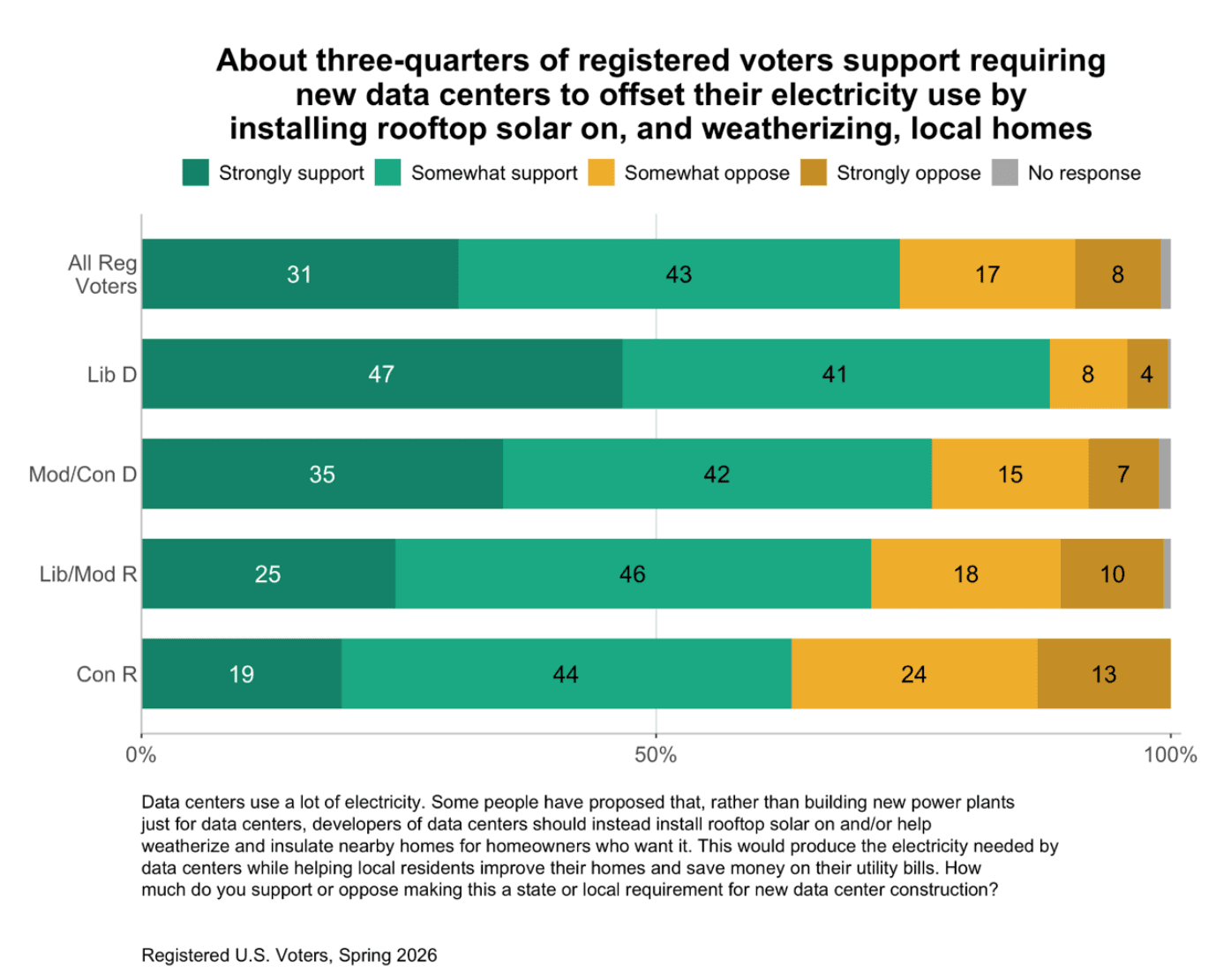
Data center developers need power, capital, and permission to build. Where household investments deliver measurable grid and community benefits, those developers should help pay for them.
This will not replace transmission, generation, storage, or grid modernization. It gives policymakers a broader strategy: build what is needed while ensuring that households and communities see direct benefits from the energy system they are being asked to host and finance.
Rewiring America puts American households at the center of an affordable, resilient, all-electric future. We partner with policymakers, industry leaders, manufacturers, workers, and communities to strengthen the electric grid, lower energy prices, and build homegrown energy solutions for all.