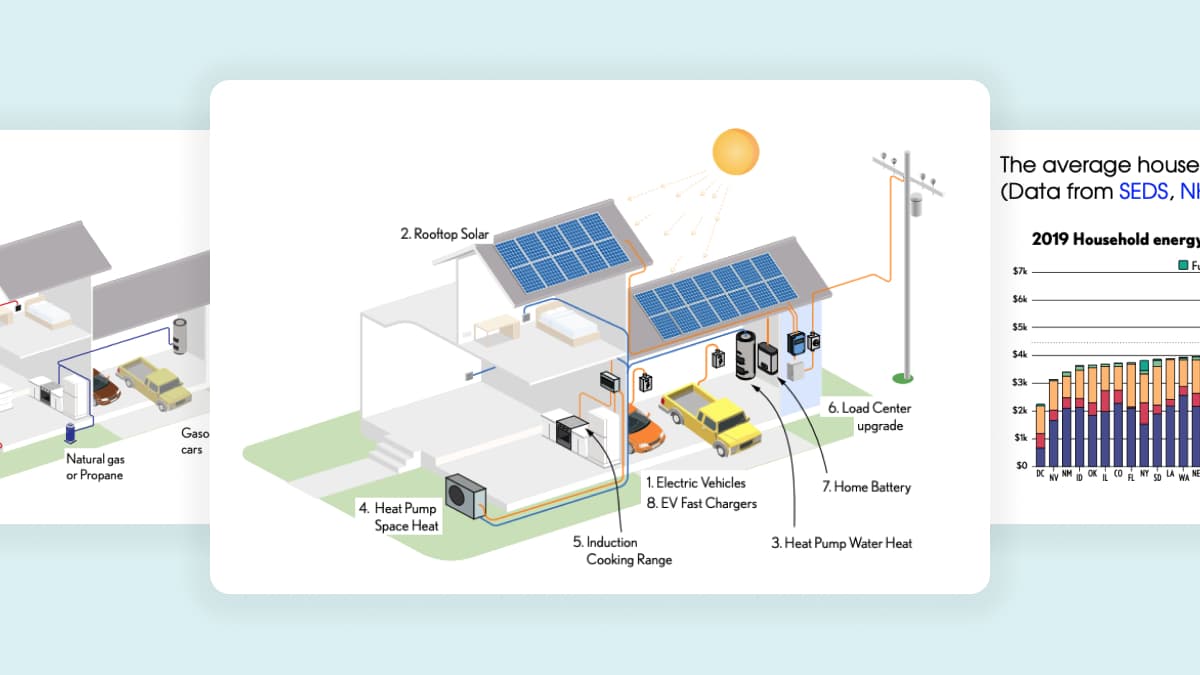
Did your household get any electrification glow-ups last year?
You did the hard work, now make sure you get those credit(s) come tax time! We chatted with a real-life Certified Public Accountant (CPA) to get the scoop on how best to prepare for your home electrification tax credit returns.
March 4, 2026 — Did you add heat pumps, solar panels, electrical panel upgrades, or other home upgrades to your home last year? We asked Certified Public Accountant Edmond Zhou, a partner in the client services group at the accounting and advisory firm BPM, for advice on how to include them in your returns as tax time approaches. (He also coaches his kids’ soccer team, which is less relevant here but still worth mentioning. Over to you, Coach.)
Disclaimer: The information presented here is for educational purposes only. It is not intended to provide specific tax guidance. For questions regarding your individual tax situation, we suggest consulting with your tax advisor.

I completed one or more home electrification projects in 2025. How do I check my eligibility for the federal tax credits?
Edmond: A homeowner should review IRS form 5695 to confirm whether their 2025 electrification projects qualify.* They should verify the project type, efficiency requirements, and that the improvements were placed in service in 2025, and keep invoices and manufacturer certifications to support the claim.
*IRS Form 5695 covers almost all of your favorite efficiency, electrification, and renewable energy upgrades. If you’re on the hunt for the EV charger tax credit, though, look for IRS Form 8911!
What documentation and/or forms do I need to provide with my tax return to receive the credits?
Edmond: Taxpayers should gather all relevant documentation, including contracts, manufacturer certifications, invoices, and proof of payment, when preparing their tax return or providing information to their CPA. This documentation is required to complete IRS form 5695, which must be attached to the tax return to claim the credit.
Can I claim a federal tax credit if I’ve already paid my estimated taxes through withholdings?
Edmond: You may claim a federal tax credit regardless of whether you paid taxes through estimated payments or withholding (they are independent of each other.)
For individuals who typically file their own returns, is the incentive paperwork manageable? Are there any common mistakes people make when claiming energy tax credits?
Edmond: Taxpayers who file their own returns should generally be able to manage the paperwork and filing required to claim the credit. Common mistakes include claiming non‑qualifying expenses, missing or incomplete documentation, misunderstanding annual and lifetime limits, incorrectly determining when the property is placed in service, and, most importantly, assuming the credit is refundable.
Any other notes or words of wisdom to share on this topic?
Edmond: I strongly recommend that taxpayers research reputable sources and fully understand the requirements associated with their electrification projects. The IRS may audit and deny the credit if the projects do not meet eligibility, record-keeping, or timing requirements. A denied credit results in additional tax due and may also trigger interest and penalties.
Thanks, Edmond!

Are there any home electrification incentives still available?
Rewiring America: Yes! While the majority of federal home electrification tax credits expired on December 31, 2025, there are a handful still available. Plus, state and local incentive programs are still running! Check our calculator to see if you qualify for a program in your area.
Household-facing incentives:
EV charger tax credit – expires June 30, 2026 >> more info here
Too many state and local programs to list! Check our calculator today to see what’s available.
Company-facing incentives:
Federal tax credits for solar, battery storage, and geothermal systems are still available to companies that install and own them. While homeowners can’t claim these credits directly, companies can use them to lower their costs — and those savings may be reflected in more affordable lease pricing for consumers. If you’re considering rooftop solar or battery storage, it’s worth asking installers how federal incentives factor into their pricing (it’s one of those win-win situations.)
Happy filing!
Have more questions?
Our FAQs page could help. Your question is still special even if it’s been asked before.