Rewiring America releases policies to lower household energy costs and make data centers pay their fair share
New toolkit gives state leaders a roadmap to make cost-saving home upgrades affordable for millions more families while meeting growing electricity demand.
As newly elected governors and legislators prepare to take office, Rewiring America today released Start with households: Two policies to lower energy costs and strengthen the grid, a practical toolkit to help states tackle two defining energy challenges of the midterm elections: rising household energy costs and growing electricity demand from data centers.
The toolkit offers a way to turn major energy investments into direct benefits for families by requiring data centers to invest in household energy resources and enabling utilities to invest in the upfront costs of energy-saving home upgrades.
Rewiring America's national modeling found that these two policies could each make home energy upgrades affordable for millions more American households, unlocking thousands of dollars in average lifetime savings while helping the grid meet growing electricity demand.
The approach has broad bipartisan support, with 74 percent of registered voters supporting requirements for new data centers to offset their electricity use by installing rooftop solar on, and weatherizing, local homes.
“Voters want relief from rising energy costs. Where data centers are built, they should at a minimum pay their own way, and better yet, put investment into improving the homes and communities around them.” said Kristin Eberhard, Rewiring America’s Vice President of Policy. “For incoming governors and state leaders, these policies can help unlock a much broader energy and affordability agenda by putting households first. They make it possible to bring investment directly into people's homes, delivering upgrades that improve comfort and unlock lasting savings. By delivering benefits families can see and feel in their own homes, state leaders can build support for the broader policies and investments needed to make energy more affordable and reliable.”
The toolkit builds on growing momentum for household and local energy resources. A new analysis from The Brattle Group and The Pew Charitable Trusts found that expanded deployment of distributed energy resources could avoid $614 billion in U.S. power system costs through 2050, helping limit future electricity bill increases. Meanwhile, new policy roadmaps from Pew and Common Charge, a coalition that includes Rewiring America, outline how states can remove barriers and make household and community energy resources a larger part of meeting electricity demand. Across the country, utilities and technology companies are also beginning to put these approaches into practice through investments in home batteries, virtual power plants, and other flexible energy resources.
Two policies to bring energy investment home
Data Centers Pay would require data center developers to cover the full costs of serving their electricity demand and direct a meaningful share of their capacity investment toward household and community energy resources. Developers would fund upgrades such as heat pumps, rooftop solar, batteries, and weatherization, with verified capacity contributions measured and credited toward their obligations. These investments can lower participating households’ energy costs while reducing or shifting demand on the grid.
Inclusive Utility Investment (IUI) helps make cost-saving home upgrades accessible without requiring households to pay the full upfront cost or take on personal debt. Under this approach, utilities finance improvements such as rooftop solar, home batteries, heat pumps, weatherization, and high-efficiency appliances, then recover their investment through a monthly charge on the customer's utility bill. Because the charge is tied to the property rather than the individual, the program can also serve renters and households with limited access to traditional financing.
Putting Homegrown Energy to work
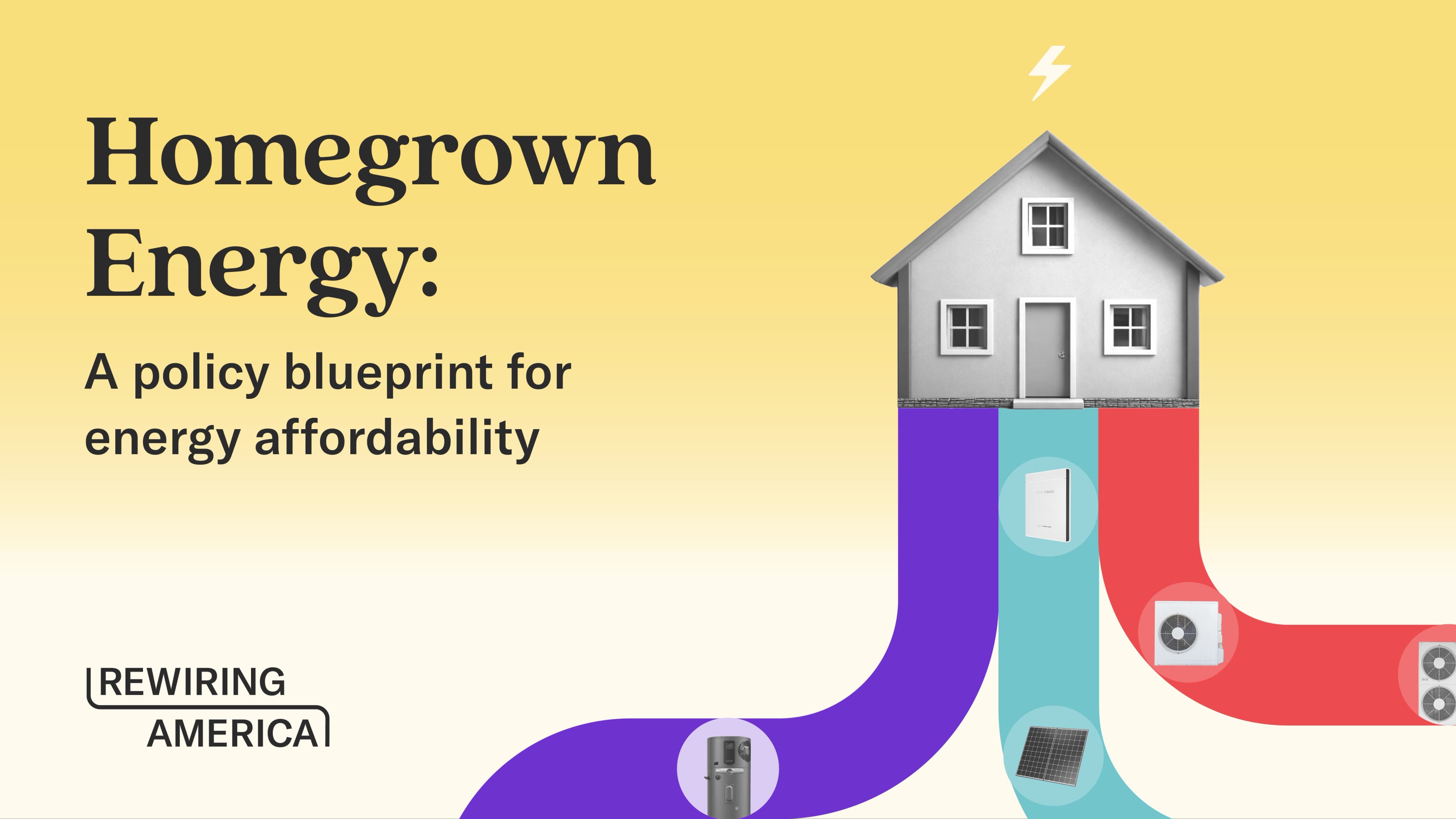
Building on Homegrown Energy: A policy blueprint for energy affordability, the toolkit helps state leaders turn the promise of household energy investment into practical action. Model legislation, executive order language, and policy design guidance offer a starting point that leaders can adapt to their state, while state-specific modeling illustrates what these policies could mean for the families they serve.
By building on existing programs and pairing investment with strong consumer protections, states can make household upgrades a lasting part of how they meet their energy needs. The opportunity is to build an energy system in which families share directly in the value their homes provide, with savings they can keep and improvements they can feel every day.
"If data centers need to be built, at least make sure there are massive benefits to nearby residents — like paying for their heat pumps or solar panels, or to weatherize their homes or give them a battery,” said Bill McKibben, Co-Founder of 350.org and Third Act. “This frees up electrons and reduces costs for people who aren't trillionaires. It's so simple that no one needed AI to figure it out."
“Millions of American families are struggling with skyrocketing household energy costs, and state governments must step up,” said Tony Sirna, Evergreen Deputy Policy Director. “Right now, data centers and utilities are contributing to the problem, but they could be part of the solution with the right policies — like Data Centers Pay and Inclusive Utility Investment,” said Evergreen Action Deputy Policy Director of Buildings Tony Sirna. “By supporting households with funding and financing, we can cut costs and build a resilient electric grid focused on household affordability.”
“Heating and cooling American homes will use four times as much energy as all U.S. data centers this year, and almost none of it is flexible or intelligent,” said Paul Lambert, Co-founder and CEO of Quilt. “Smart, highly efficient heat pumps change that, turning home load into grid capacity that offsets data center demand. Start with households gives states the playbook, and we’re proud to support it.”
“By making home solar and batteries easier and more affordable to install, millions more American families will be able to produce cheap electricity from their rooftops to power their lives and save on their utility bills,” said Nick Josefowitz, Chief Executive of Permit Power. “Instant permitting and interconnection can reduce unnecessary costs and delays, helping families get solar and batteries installed and start saving sooner.”
“Homes are some of the fastest grid capacity we can build," said David Richardson, CEO and Co-Founder of Elephant Energy. "Heat pumps and batteries go in quickly, lower families’ bills, and free up room on the grid for new demand. And when data centers invest in the homes around them, they help ensure those communities share directly in the benefits of energy investment. Start with households gives states a clear way to make that happen, and we’re excited to help put it to work."
“States have an opportunity to drive new clean energy investment directly into homes, making load growth an economic benefit rather than a financial burden,” said Arnab Pal, Executive Director of Deploy Action. “Clear requirements for data centers to invest in household energy, paired with utility financing for home upgrades, makes everyone part of the solution, by expanding clean energy deployment and spreading out infrastructure.”
“Families and communities are being asked to pay for costly power plants that will take years to build, while solar panels, batteries, and smart thermostats that could lower bills are already operating in their homes and neighborhoods,” said Mary Rafferty, Executive Director of Common Charge. “Hyperscalers can and should be part of the solution to today’s energy challenges. Instead of spending years building expensive new power plants and offloading the cost on local ratepayers, data center companies can compensate households for putting existing batteries, smart thermostats, and flexible energy tools to work now.”
Rewiring America puts American households at the center of an affordable, resilient, all-electric future. We partner with policymakers, industry leaders, manufacturers, workers, and communities to strengthen the electric grid, lower energy prices, and build Homegrown Energy solutions for all.