
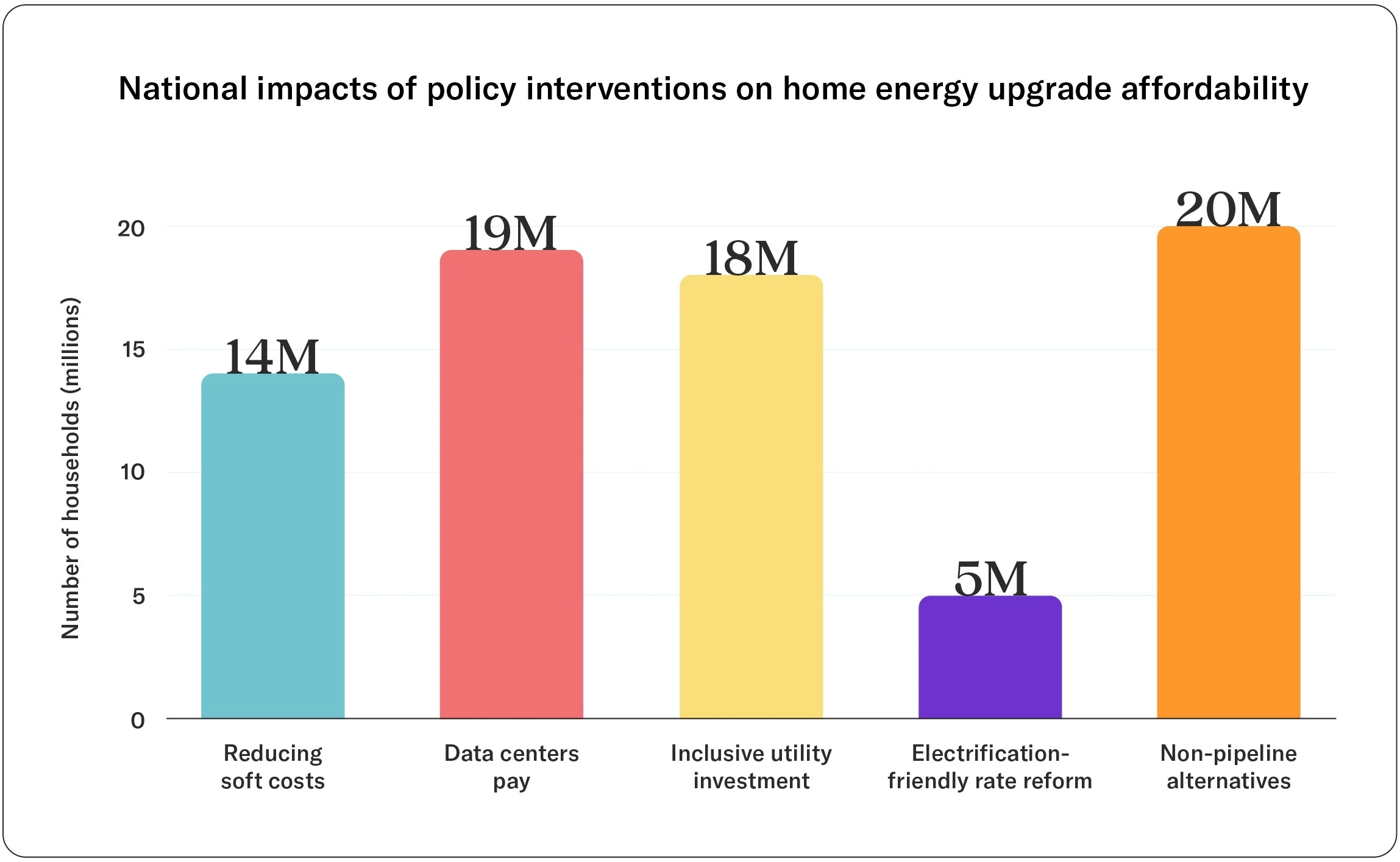
This spring, our team released the second report in our Homegrown Energy series. The latest release presents six actionable policy proposals that would make electrification upgrades affordable for 96 percent of eligible households. The math sounds great, but what do these changes actually mean for individual households? We sat down with one of the report’s authors, Lead Data Scientist Miki Verma, to crunch the numbers on these policies’ power to help households save.
Rewiring America: The first policy change discussed in the report is “soft cost reductions.” There's a note that reducing soft costs is so beneficial to every other upgrade and policy, that you "treat it as a baseline condition for the rest of the analysis.” How did the team identify soft cost reforms as being so important to the rest of the policies?
Miki Verma (MV): First, let’s break down what we mean by soft cost reforms. So, there are all kinds of red tape permitting hurdles when it comes to putting solar and battery storage in your home. Here in the U.S., you might be required to have several rounds of people visit your home to sign off on one piece of the process. Those checks can also vary by state and county. Compare that to a place like Australia, where they've streamlined the permitting process so that everyone is playing with the same rulebook. This approach has brought down these soft costs so that the price of installing solar is just so much lower. Further, this is a very politically palatable, location-agnostic recommendation — everyone can get behind reducing red tape.
So from a policy perspective, that's why we started with soft cost reform as our baseline condition. From more of a quantitative perspective, one of the things that we noticed during modeling is that including solar and storage (which is still unfortunately quite expensive) results in fewer homes in the affordability realm. Because this higher upfront cost is a big barrier to affordability, reducing soft costs really improves the economics of every upgrade and subsequent policy. Further, a home that has solar and battery storage provides a major grid benefit at the same time. That contribution to grid capacity comes into play with other policies in the report, like investment by hyperscalers (the tech companies building big data centers) as well as creation of virtual power plants.
“Everyone can get behind reducing red tape.”
RA: There are a lot of big numbers in this report. Could you break down what the impacts could look like for a single household if just one of these policies were enacted?
MV: Sure, let’s look at the second policy: “data centers pay,” or requiring large new energy users to invest in distributed resources for households. I’ll use an example of a single-family home in Georgia that's currently on electric resistance heating. Electricity in that region is relatively cheap, compared to the rest of the country. Average monthly bills might land somewhere around $130. That number will definitely be higher for a home on electric resistance because they have a much higher winter electric load.
So, let's say they were upgrading all of their appliances. Switching to a heat pump, upgrading their stove and clothes dryer to electric options, installing a heat pump water heater, and then also getting solar and batteries. With most of those upgrades, they'd be reducing that peak demand on the grid. Freeing up capacity on the grid is something that a hyperscaler would potentially be interested in paying for. So what we modeled is what would happen if that hyperscaler paid for a portion of the upfront costs for those electric upgrades. That home would end up saving something in the neighborhood of around $60 a month. An extra $60 in your pocket every month makes a difference. And what’s really significant is the effect of that extra $60 a month over the lifetime of those appliances. In this scenario, the initial hyperscaler investment closes the upfront cost gap for that household. The savings that those appliances then generate over their lifetime end up making the choice to electrify the home the smarter economic choice than if they had installed a less efficient alternative, somewhere in the ballpark of $26,000 over the equipment lifetime.
RA: Can you talk through the 1+1 = 4 concept? What does it mean in terms of stacking policies for maximum impact?
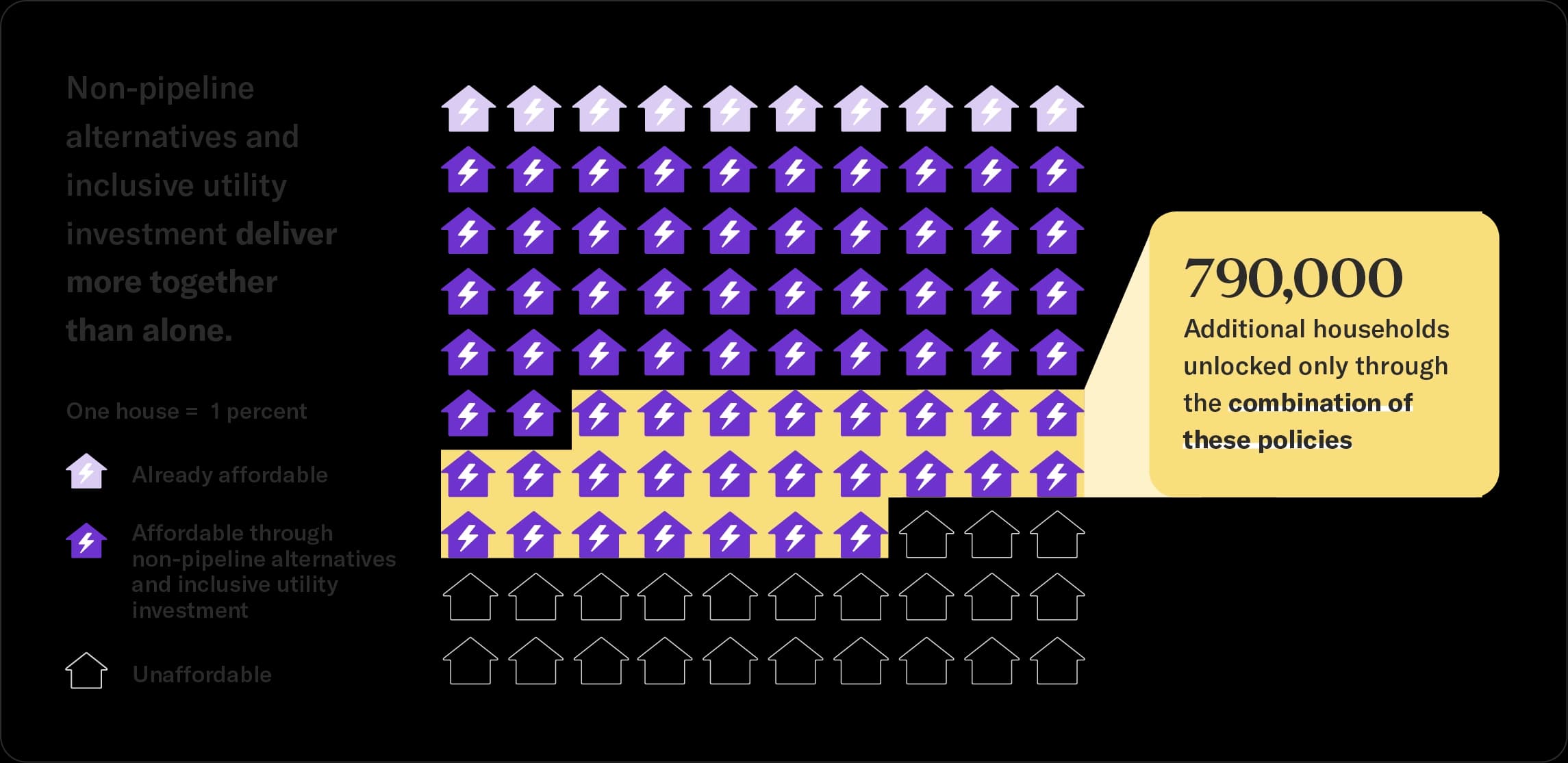
MV: I think it's easier to dive in with a particular example and then I can kind of zoom out. Let's take Illinois. Assuming soft cost reform has already taken place, electrification upgrades are now affordable for about 10 percent of households. If we add policy number five, non-pipeline alternatives, we increase affordability to an additional 24 percent of houses. Policy number three, inclusive utility investment, can bring another 14 percent of houses into affordability. The real magic comes in though when we look at what happens when these two policies work together. If Illinois were to enact both policies at the same time, an additional 25 percent on top of the 38 percent from each policy alone, or 790,000 households, tip into affordability. This is because for these households, neither policy alone would be enough to get them over the affordability line, but together they do! Passing multiple, complimentary policies together delivers results that are greater than the sum of their parts, which is why we describe it as 1+1 = 4.
Looking for more insights on your state?
Find your state here to see what policy changes could do there.