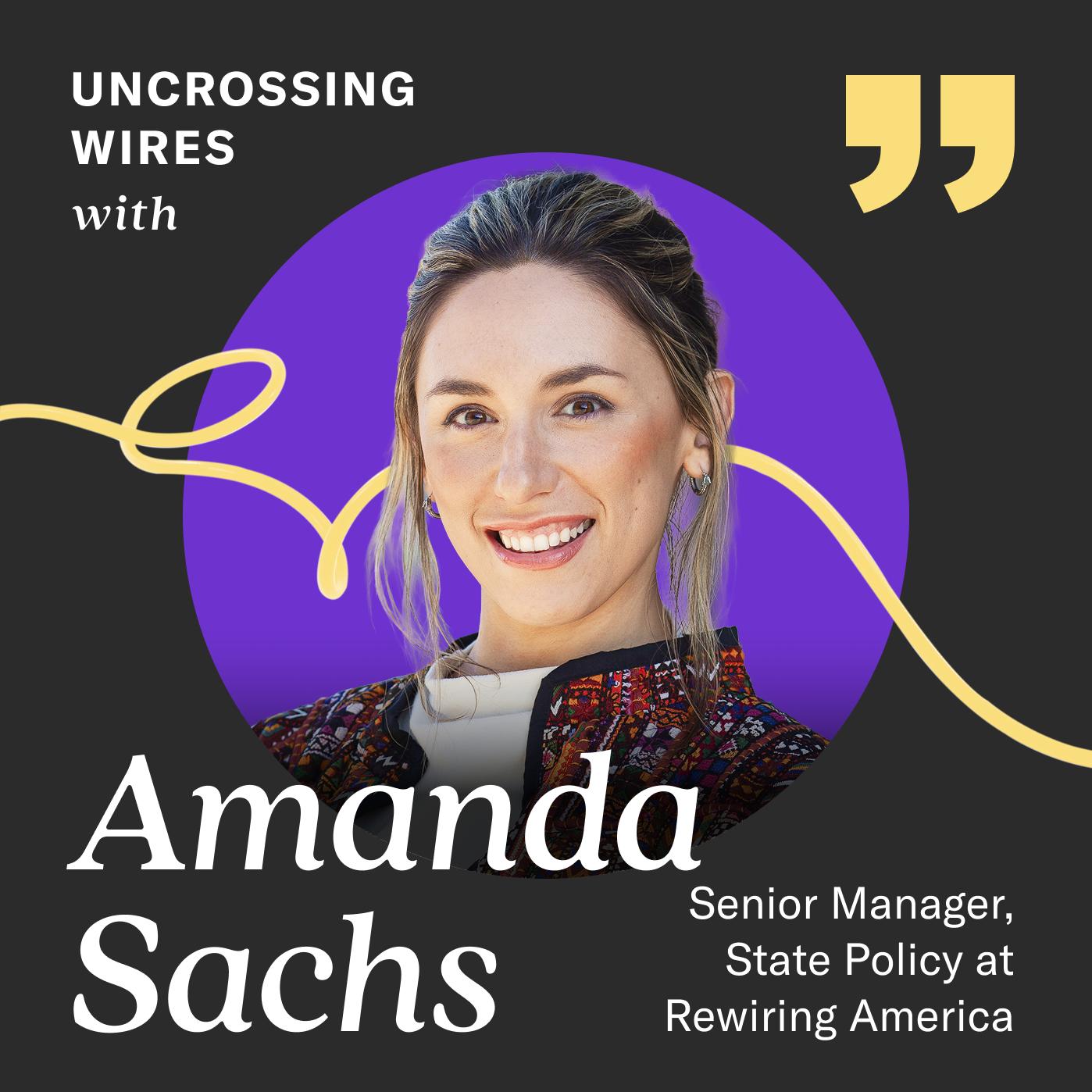
One of the core pillars for household electrification in our Homegrown Energy series is inclusive utility investment: a long name for a great policy that you might never have heard of! We sat down with our Senior Manager of State Policy, Amanda Sachs, to break it down.
Rewiring America: Let’s start with the basics. What is inclusive utility investment, who is it for, and how does it work?
Amanda Sachs (AS): The biggest barrier to home energy upgrades is high upfront costs. The main goal of inclusive utility investment (IUI) is to address that problem by having the utility pay for upgrades up front, and then recover the costs through a fixed charge on a customer’s monthly bill. Even with that charge added, annual bills should stay the same or become even lower than before, because of how much more efficient the home energy upgrades are than what they’re replacing. For example, a heat pump is 3 times more efficient than electric resistance heating, so upgrading to a heat pump system is often a no-brainer. In Massachusetts, more than 47,000 households that use electric resistance or other inefficient electric heater would be able to pay $0 down for a heat pump with inclusive utility investment (before rebates) and still save nearly $4,000 a year in net annual cost while paying the utility back for the upfront cost of the heat pump over its lifetime.
The way it works is that before moving forward with an installation, the utility or third-party administrator first conducts a site-specific energy consumption audit and checks the billing history of the location. If their modeling shows the household won’t save from the upgrade, the installation doesn’t happen. In some scenarios, the household may decide to contribute to the upfront payment in order to qualify. Either way, the cost recovery charge on the bill stays attached to the property, so IUI doesn’t require the household to take on personal debt.
"[The] charge stays with the property address, not the person."
RA: You mentioned inclusive utility investment not being personal debt. How is this different from a loan?
AS: That’s right. In a loan, a household borrows money and owes it back no matter what, and the obligation follows that person (and their credit score!). With inclusive utility investment, the cost recovery charge is tied to the utility bill on the premises where the home energy upgrade takes place. If the person living at the address at the time of the upgrade later decides to move somewhere else, that charge stays with the property address, not the person. So, the next time a bill comes in, it gets paid for by the new tenant, not the old one.
Spreading out the upfront cost is a clear and big benefit, and the structural savings come from the utility financing the upgrade, which has access to cheaper funding than households typically have access to.
RA: Are there places in the country where this is already happening?
AS: Inclusive utility investment has been operating for well over a decade, with programs, pilots, or implementation activity in about a dozen states. Most early adopters were rural electric cooperatives and municipal utilities, including in Kansas, Arkansas, North Carolina, and Kentucky, but investor-owned utilities have increasingly adopted the model too, including Ameren and Evergy in Missouri. California and Illinois are also advancing implementation efforts and Massachusetts has municipal utility pilot programs underway in Ipswich and Peabody.
The track record is really promising. There's no single "success rate," but I'd look at a few key measures: actual energy and bill savings, customer satisfaction, participation — especially among customers who historically haven't been able to access upgrades — and utilities' ability to recover their investments.
Roanoke Electric Cooperative in North Carolina has enrolled more than 10 percent of its residential customer base — that’s 1,200 households — into an IUI program. Considering that electric co-ops have far fewer staff and financial resources than investor-owned utilities, this is a promising sign that this model can reach meaningful scale.
So overall, there's strong evidence that IUI can work well, particularly for removing upfront cost and financing barriers that have historically prevented many households from accessing efficiency upgrades.
"There's strong evidence that IUI can work well, particularly for removing upfront cost and financing barriers that have historically prevented many households from accessing efficiency upgrades."
RA: What kind of guardrails are necessary to make this work?
AS: One of the most important parts of a successful inclusive utility investment program is strong consumer protections, of which, there are a lot of options. The ones we consistently push for are:
Screening households for income-eligible programs: if they can get a free or discounted home energy upgrade through a different type of program, they should be directed to those first.
Documenting landlord and tenant consent: Before enrolling properties that will be rented to tenants, lease disclosures must clearly explain the cost recovery charge, expected savings, payment duration, and conditions for adjustment.
Using the right modeling for savings estimates: We recommend including transparent, independently validated modeling methodologies, such as BPI-2400 calibrated modeling or equivalent standards where appropriate.
Conducting mandatory inspections prior to starting cost recovery charges: The implementer must perform quality-control checks of completed projects, and monitor performance to ensure energy usage aligns with expectations.
Establishing no-fault protections: If an upgrade fails through no fault of the customer, the program must cover repairs or replacements and suspend cost recovery charges while the equipment isn’t working. If the equipment cannot be repaired or replaced, any remaining charges must be canceled.
The bottom line: IUI’s success depends on careful program design, robust consumer protections, and verified customer benefits. Our team is actively working with national partners like Clean Energy Works and state-based organizations to weigh in on legislation, regulations, and program design around IUI.
RA: What is one aspect of this work that really excites you?
AS: To me, one of the most exciting things about IUI is its potential to reach renters and debt-averse households. These are typically a difficult group of households to upgrade to electric, because it’s hard to justify paying for improvements on a home you don't own, or take on debt if you’re already having a hard time making ends meet. Inclusive utility investment is a way to make upgrades more accessible to them, as well as for landlords, who are motivated to participate because there’s no cost to them to upgrade their tenants’ appliances. With strong consumer protections, ongoing performance monitoring and accountability — we can ensure participating households are better off.